
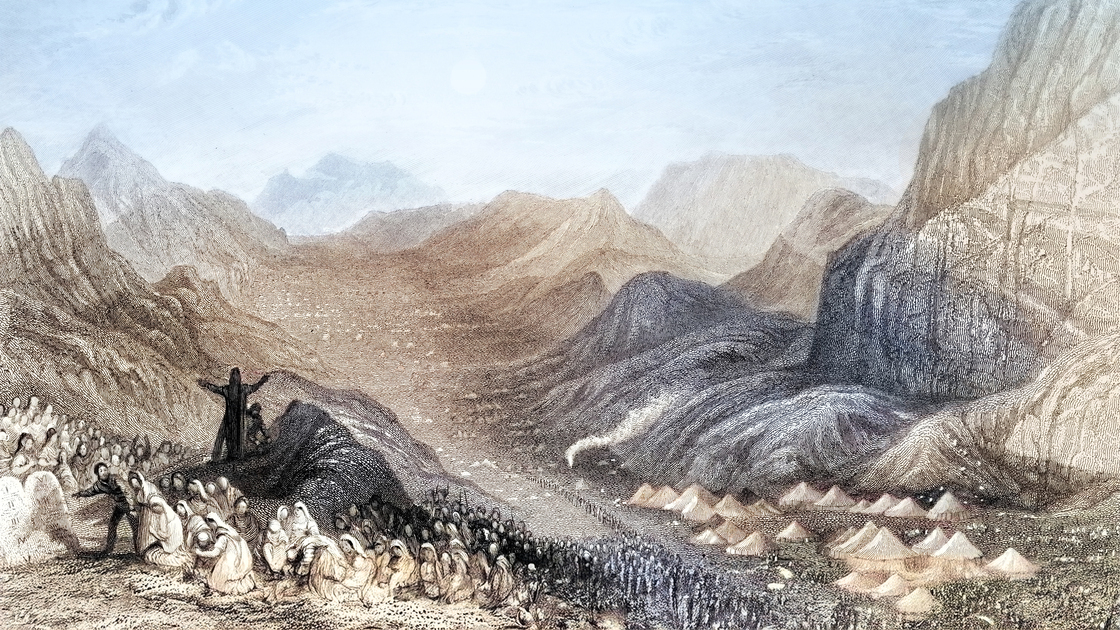
Ancient Israel’s history, from its slavery in Egypt to the Red Sea crossing to its journey to Mount Sinai and its conquest of Canaan, is history for our spiritual learning (1 Corinthians 10:11). God wants these lessons engraved on our minds and hearts so we learn to rely entirely on Him with unwavering belief in His power to deliver us from trial and test and to lead us to the eternal Promised Land.
In Leviticus 23:15-16, God commanded Israel, “And ye shall count unto you from the morrow after the sabbath, from the day that ye brought the sheaf of the wave offering; seven sabbaths shall be complete: Even unto the morrow after the seventh sabbath shall ye number fifty days; and ye shall offer a new meat offering unto the Lord.” (See also Deuteronomy 16:9.)
After Israel’s exit from the Red Sea to the Day of Pentecost, Israel would rest seven Sabbaths. The Good News of July 1971 says, “Though the people stopped to rest daily, or several times a day, to eat, sleep and take care of their personal needs, it was every Sabbath that they encamped to rest for a day” (emphasis added). God was causing Israel to observe His seventh-day Sabbath as their father Abraham had before they went into Egyptian slavery (Genesis 2:1-3; 26:5; Exodus 31:17).
Why should this be important to you? What does this ancient history have to do with your life?
Most people don’t realize the Bible is meant for today—right now—for your life. Read it in 1 Corinthians 10:11: “Now all these things happened unto them for ensamples: and they are written for our admonition, upon whom the ends of the world are come.”
2 Timothy 3:16-17 also tell us that this history is for our learning so that we may be corrected, instructed in righteousness and thoroughly furnished in works of obedience to God’s Ten Commandments. Christ is returning shortly, and only those who are zealously preparing will be there to join Him in His Kingdom!
God records specific details about some of these Sabbaths in the lead-up to Israel’s first Pentecost at Sinai. These contain lessons vital for us to understand and profit from.
Marah
We begin with Marah, the first Sabbath (Exodus 15:22-23). For three long days there had been no water for the Israelites to drink or to refresh their animals. Arriving at Marah (meaning “bitter”), ancient Israel found only bitter water. God was testing them. Would they trust Him to care for all their needs? Certainly God had foreseen this predicament—and even planned it.
God told them that if they would keep His commandments, He would heal them of their sicknesses and diseases. Don’t let that escape your notice: God mentioned obedience to His commandments before He established the Old Covenant with ancient Israel. His spiritual law had already been in effect from the time of Adam and Eve!
The bitter waters are typical of lawless human nature—a deadly poison to all humanity. Jesus Christ is a healing Physician (Exodus 15:26; Malachi 4:2; Matthew 9:12)—He heals physically and spiritually from the inside through forgiving sin and by the keeping of the commandments, statutes and judgments of God.
Here God made these waters drinkable for the Israelites (Exodus 15:25-26). We can liken these sweet waters to God’s Holy Spirit, which is given after repentance at baptism through the laying on of hands from a true minister of God (Acts 8:15-17; 2 Timothy 1:6). We continue to drink in this Spirit daily through repentance, obedience to God, prayer, study, fasting, spiritual meditation and Christian fellowship. The gift of God’s Spirit imparts to us Christ’s own dynamic faith that then empowers our obedience and that makes us pleasing to God. Thus, we are healed by the miraculous and supernatural intervention of the love of God and by the faith of Jesus Christ.
Though the Bible record does not say explicitly, this miracle likely occurred on the Sabbath day, Abib 24, three days after crossing the Red Sea on the last day of Unleavened Bread (for an explanation of dates and timing of the Exodus, see ArmstrongInstitute.org/1060). Christ regularly healed people on the Sabbath. And the Sabbath pictures our eternal rest and complete healing from human nature and sin by a resurrection from the dead in the Kingdom of God (1 Corinthians 15).
Elim and the Red Sea
On the second Sabbath, the first day of the second month Iyar, at Elim, the Israelites encountered 12 wells, or springs as it should be translated, and 70 palm trees (Exodus 15:27). By these refreshing springs and palm trees, they found rest.
It is interesting that Christ called 12 apostles and later sent out 70 disciples to announce where He intended to visit, an advance notice of an appearance (Luke 10:1). He even gave them authority to cast out demons (verse 17).
We too can only find spiritual rest by surrendering to the living waters flowing from God and Christ (John 7:37-39)—the Holy Spirit—and to God’s government. If we continue in sin after we receive God’s Spirit, there will be no entrance into the Kingdom of God. This means we will die in our sins.
After leaving Elim, the Israelites traversed a mountain pass, on the other side of which the Red Sea once more spread out before them (Numbers 33:9-10). The third Sabbath was presumably kept by the Red Sea on Iyar 8, and the Bible records no event or happenings. Certainly, with such fresh memories and the sea in sight again, many would have reflected and spoken on this Sabbath about their former life in Egypt and God’s miracles in delivering them through the Red Sea.
The Wilderness of Sin
The next encampment, “in the wilderness of Sin” (Numbers 33:11), was “on the fifteenth day of the second month” (Exodus 16:1). Verses 2-4 cover the instructions given to Israel just before the fourth Sabbath there in the wilderness—and they concerned Sabbath observance. Here we see a direct connection between the encampments and the Sabbath. Keep in mind, again: This is before God gave Israel the Fourth Commandment at Mount Sinai. The patriarchs kept the seventh-day Sabbath, but their descendants had lost this knowledge in Egyptian captivity.
Genesis 2:1-3 tell us God instituted the Sabbath on the seventh day of the week, when He rested from all His work. He created the Sabbath by resting. Sabbath means rest. In other words, stop your daily work, cares and hobbies, and draw close to God.
Soon, God will bring all mankind into the knowledge of the Sabbath. This weekly holy day pictures our eternal rest from sin in His divine, everlasting, family Kingdom!
In the book of Genesis, God did not name the days of the week; He simply numbered them one to seven. The word sabbath first appears in Exodus 16:23. Today, the days of the seven-day week are named after pagan gods in most languages. Many languages, however, still use a word for Saturday that derives from the word sabbath. This is partly because while God has allowed man to change the names of the days of the week, and Satan has deceived man as to which day is the true Christian Sabbath, God has never allowed Satan to change the length of the week—though some have tried! A week is still seven days. Sunday—Satan’s day of worship—is the first day of the week.
By withholding manna on the seventh-day Sabbath for 40 years, God taught ancient Israel which day the Israelites ought to rest—as well as which day was the preparation day for the Sabbath (verses 5, 22-24).
Moses ordered Aaron to preserve a pot of manna for all generations (verses 32-34). Christ explained its symbolic significance in John 6:49-51, 57-58: Spiritual manna comes down from heaven. It is the sacred Word of God. Today, it is Jesus Christ in print, the pages of the Holy Bible.
Christ said we are to live by every Word of God (Matthew 4:4). So the manna represents God’s precious life-giving truth from the Bible. If we consume it daily and let it rule our lives, God’s Word will lead to great, enduring faith and eternal life.
Connecting Exodus 16:25 and 17:1 indicates that Israel also spent the fifth Sabbath, Iyar 22, after the Exodus in the wilderness of Sin, which is described as geographically located between Elim and Sinai (Exodus 16:1). They then traveled to Rephidim (Exodus 17:1), which is located just before the wilderness of Sinai (Exodus 19:1-2).
However, Numbers 33:12-13 detail two additional stops prior to Rephidim: Dophkah, then Alush. The fact that the Exodus account does not mention them may suggest that one or both of them were minor, peripheral encampments or even part of the Israelites’ time in the wilderness of Sin.
No details are recorded, but the name Alush, meaning “from” or “out of,” corresponds to Israel coming out of the wilderness of Sin and marching toward Mount Sinai. And if we today accept and obey God’s command to keep His Sabbath, we come out of Satan’s deception and the pagan customs of this world.
Rephidim
Exodus 17 recounts Israel’s history at their next stop, Rephidim, meaning “resting places,” where they likely spent their sixth Sabbath on Iyar 29.
To summarize, there was no water to drink. Israel began to chide Moses and complain that he had brought them out of Egypt to kill them. Moses turned to God. God told him to take his rod (symbolic of God’s government) and to strike the rock, and water would come out of it (verses 1-6).
Moses gave Rephidim the nicknames Massah and Meribah—meaning temptation, strife and contention (verse 7; Deuteronomy 33:8). What happened at Massah and Meribah? The Apostle Paul gives us great insight in Hebrews 3:7-19. This powerful passage shows what a terrible provocation to God Israel’s faithlessness was! And it clearly shows that this incident is a strong warning for God’s people in this end time.
Harden not your hearts, Paul writes (verses 8, 15; 4:7). Don’t provoke God with an evil heart of unbelief! And he makes clear that this incident involved the Sabbath. In Hebrews 3:13, “To day” refers to the Sabbath. “… God inspires the warning to His Church, ‘Harden not your hearts, as at Meribah, as on the day at Massah in the wilderness.’ This rebellion was rebellion against God’s Sabbath!” Mr. Armstrong wrote in the May 1967 Good News.
God greatly desires to give man rest from his wretched sins and their penalties—eternal rest in His divine Family. But ancient Israel rejected God’s resting place—His holy Sabbath—as many of His people have done today.
Are you truly resting on God’s seventh-day Sabbath? Are you being instructed on the Sabbath day by one of God’s true ministers?
We must cement this lesson in our minds and hearts. God tells us to rest, and to receive the faith and spiritual knowledge required for salvation on His holy day! And what a blessing it is. God’s presence, through His Spirit, is in this weekly observance—that is what makes the Sabbath holy.
Amalek Attacks
Now continue with the story. Exodus 17:8-13 record the event of King Amalek and his army coming to fight Israel. This was just after the Israelites showed a lack of faith and trust in God. This led them into their first war!
Think about your Sabbath-keeping. Pastor General Gerald Flurry has said that if you have a good Sabbath, you will have a good week. Well, ancient Israel fought with God on the Sabbath. Is it any surprise that Satan was right there the next day? When we reject God and break His law, Satan pounces—family arguments, marriage problems, child-rearing problems, problems at work and so forth. Like a boomerang, sin comes around to punish us for our lawbreaking.
Deuteronomy 25:17-18 recount Amalek’s attack on the rear of Israel’s travel caravan. This archetype of Satan targeted the feeble and weak, exactly as he does today to those who continue to sin and refuse to repent.
The big lesson from Massah and Meribah is that sin weakens faith. We cannot fight our own battles. We cannot keep God’s commandments in our own feeble power. Proper Sabbath-keeping will renew and build our faith in God so we can be empowered by Christ in us to fight against sin and permanently remove it from our lives.
During the battle God pointed them again to His government as administered through Moses (Exodus 7:9-13).
God’s Government
After that battle, between that Sunday and the Day of Pentecost the following Sunday, God used Jethro, Moses’s father-in-law, to reveal to Moses some details of His top-down pattern of government: amplifying the reach of His human leader through an organized support team. This history is covered in Exodus 18—excellent reading before Pentecost.
God’s government preserves God’s law. It was only after God established this expanded, organized government that He would give His codified, fiery law to Israel.
Then, on the first day of Sivan, “On the third new moon after the people of Israel had gone out of the land of Egypt, on that day they came into the wilderness of Sinai” (Exodus 19:1; English Standard Version).
The Israelites’ seventh Sabbath was observed at the base of Mount Sinai. It was here that God instructed Moses to prepare the nation to receive His law (verses 10-11). This happened on the annual festival of Pentecost.
For Our Admonition
After Israel’s figurative baptism in the Red Sea in its journey to Mount Sinai, we find that the Israelites did not enthrone God in their thinking.
Speaking about ancient Israel, God lamented in Deuteronomy 5:29, “O that there were such an heart in them, that they would fear me, and keep all my commandments always, that it might be well with them, and with their children for ever!” Truly, God wants what is best for us.
1 Corinthians 10 refers to the whole history of Israel’s exodus and its wanderings in the wilderness. Christ was leading them, but they rejected His leadership.
Paul tells us that those events were recorded for us today, to furnish lessons we can learn without having to experience the harrowing penalties they earned and paid—lessons of hard experience they did not learn and ultimately squandered.
Are we learning the lessons from our sins today? God wants us to work hard to come out of sin and obey His law. Go to the throne of grace (Hebrews 4:16) and ask God for the depth of repentance you need—even His loving punishment if that’s what it will take to turn your life around.
On the Day of Pentecost in Acts 2, God gave Christ’s disciples the Holy Spirit—the divine love to obey this right, holy and just spiritual law.
Do you have God’s Spirit? If not, you need it. The first condition to receiving God’s Spirit is repentance—turning from sin (1 John 3:4) to obeying God and His law. The second condition is faith toward Christ (Acts 20:21).
If we crucify our old man and discard that old body of sin, keeping it nailed to the stake, Christ will then live in us (Galatians 2:20). It is Christ in us that is the only hope of glory (Colossians 1:27). That means His righteousness in us, imparted by His saving faith.
Christ will lead us from within to enthrone God in our thinking—all by the power of the Holy Spirit. You need this help.
This beautiful transformation into the spiritual mind and character of Christ makes us Christ’s true disciples, His students. It will also lead us to obey God and please Him—just as Christ did by the same Holy Spirit in His own short physical life.
As the Pioneer and the Perfecter of His faith within us (Hebrews 12:2), the living and active Jesus Christ will lead us into the spiritual Promised Land—the glorious ruling Family of God!