
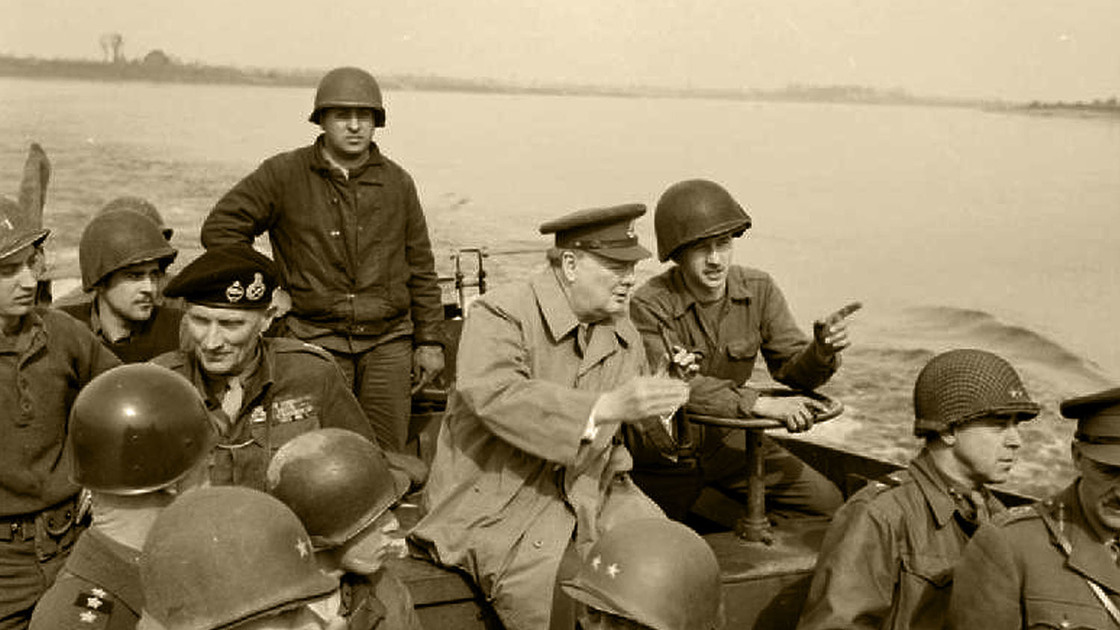
“Churchill could not be judged by ordinary standards; he was different from anyone we had ever met before, or were ever likely to meet again,” wrote General Hasting Ismay, one of Churchill’s military assistants, on August 2, 1941, to General Claude Auchinleck, commander of the Eighth Army in North Africa. In the autumn of that year, the epic battle in the sands of North Africa with the German and Italian forces was intensifying. Ismay wrote the letter explaining Churchill’s war thinking to his friend, who was exasperated by the prime minister’s incessant demand for action against the enemy.
“As war leader, he was head and shoulders above anyone that the British or any other nation could produce. He was indispensable and completely irreplaceable,” continued Ismay. “His courage, enthusiasm and industry were boundless, and his loyalty was absolute. No commander who engaged the enemy need ever fear that he would not be supported. His knowledge of military history was encyclopedic, and his grasp of the broad sweep of strategy unrivaled.”
Ismay then came to the very essence of Churchill’s philosophy on war. This kernel of truth might be the best summation of Churchill’s thinking as the leader of Britain’s forces: “He was not a gambler, but never shrank from taking a calculated risk if the situation so demanded. His whole heart and soul were in the battle, and he was an apostle of the offensive. Time and again he would quote from Nelson’s Trafalgar memorandum: ‘No captain can do very wrong if he places his ship alongside that of an enemy.’”
Churchill was an “apostle of the offensive,” an endless advocate of attacking and destroying the enemy. This war thinking was key to Churchill’s war leadership. He was a warrior first, and then a politician. His disdain for defensive tactics and timidity was an essential element to the winning of World War ii. The military officers around him may have been exhausted with his constant questions, exhortations and ideas, but it was that constant prodding that ensured the vast war machinery of the British Empire effectively engaged the enemy.
This “apostle of the offensive” was shaped by a lifetime of learning about human nature and warfare. Churchill had the practical experience of being a soldier and witnessing the gruesome spectacle of battle. He had an encyclopedic knowledge of military history through long hours of study. Churchill also learned from the example of many other famous war leaders.
These three elements of experience, education and example had given him the profound understanding that the only way to achieve victory was through the offensive.
Churchill’s method was to “pester, nag and bite,” constantly prodding his subordinates to attack the enemy, come up with fresh plans for the offensive, and keep a forward-looking perspective.
Churchill believed in the doctrine of the offensive, and the doctrine of spiritual offensive warfare is what the Bible teaches. That is God’s approach to waging war against sin.
This is the war thinking true Christians must have: We must use experience, education and example to build our offensive war thinking.
When Churchill returned as First Lord of the Admiralty in 1939, he immediately began to infuse a spirit of action and attack.
“Winston Churchill refused to leave the waging of the war at sea to the admirals alone. Rather he sought to impose his imprint on the navy. With Churchillian energy, he suggested strategy and tactics,” writes Bradley Tolppanen at the International Churchill Society. “At every turn, he encouraged the offensive and did not hesitate to prod the navy’s flag officers. He badgered those he thought lacking in fire, sacked or sidelined those who had incurred his wrath, respected those who had proven ability even if they disagreed with him, and promoted those he admired.”
Churchill was immediately met with strong resistance against any kind of offensive action: His cabinet colleagues and service chiefs were afraid of German reprisals.
Pastor General Gerald Flurry draws attention to this history in How To Be An Overcomer, in a chapter on “Offensive Warfare.”
“Prior to World War ii, Winston Churchill grew increasingly frustrated with Britain’s defensive maneuvers,” he writes. “He wanted Britain to brace itself to accept the ‘hazards of action,’ as Martin Gilbert wrote in his biography. Later Churchill said, ‘Ever since the beginning of the war, we had let the initiative rest with Germany.’ Germany was constantly on the offensive. Churchill said, ‘All this makes me feel that under the present arrangements, we shall be reduced to waiting upon the terrible attacks of the enemy.’”
Mr. Flurry continued: “Now notice this: ‘The offensive,’ Churchill said, ‘is three or four times as hard as passively enduring from day to day. It therefore requires all possible help in early stages. Nothing is easier than to smother it in the cradle. Yet here, perhaps, lies safety.’ If you want to be safe, Churchill said, go on the offensive. This principle applies to Christians and to the Church. The Bible has much to say about offensive warfare.”
Spiritually, it is much easier to be passive day to day. It is easy to only endure (which God commands us to do in Matthew 24:13) and not be growing! It is three or four times harder to wake up and pray each morning, to be corrected in our Bible study, to fast often for overcoming sin, or even to ask for correction from the ministry. That is all harder, but that is the only way we can be spiritually safe. We may be passive spiritually, but our adversary is not. Satan the Devil is always vigilant, stalking us, looking for the opportune time to consume us (1 Peter 5:8).
It is only by constantly pressing ourselves forward to grow in faith and obedience, and to overcome sin, that we follow this principle of spiritual offensive warfare found in James 4:7-8: “Submit yourselves therefore to God. Resist the devil, and he will flee from you. Draw nigh to God, and he will draw nigh to you. Cleanse your hands, ye sinners; and purify your hearts, ye double minded.”
Like Churchill, we must use our life experiences to learn the nature of real spiritual war. We must set about to educate ourselves on spiritual war, consuming the Bible, Church history, and the literature about how to live God’s way of life. Then, we must follow and learn from the example of great spiritual war leaders (Hebrews 13:7). In this end time, we have been blessed with the examples of two apostles of the offensive: Herbert W. Armstrong and Mr. Flurry.
Once we have built this war thinking in our minds, we must then display it in our lifestyle. One of Churchill’s frustrations was with military leaders who could intellectually plan an operation or agree with a concept, but then lacked the courage and determination to actually destroy the enemy.
As Christians, we must not fall into the same trap. We may study the Bible and literature, agreeing with what it teaches about growing and fighting sin, intellectually understanding what we must do, but then fail in the application: We must be doers of the word, not just hearers only (James 1:22).
As Nelson’s Trafalgar memorandum said, “No captain can do very wrong if he places his ship alongside that of an enemy.” The confusion of battle can derail carefully formulated strategy, so Nelson encouraged his captains that if they don’t know what to do, find the nearest enemy ship and fight.
We must take the same approach. As we grow in grace and knowledge, we may encounter situations we don’t understand, or trials that leave us confused. But as we search for God’s war direction, don’t give up; find the spiritual enemy and come to grips with him!
The Bible rewards those who overcome their own human nature, this world, and Satan himself through the power of God’s Holy Spirit! We will not enter the Kingdom of God in retreat, or by passively defending day by day. True Christians enter the Kingdom on the offensive, taking it by force (Matthew 11:12).
We must all work to first build this offensive war thinking in our minds, and then live it day by day!
Churchill was a statesman, a prolific writer, a successful politician, a watchman, an artist, a brick layer, a man who achieved so much in his life. Yet perhaps his greatest legacy is that he was the apostle of the offensive God used to save Western civilization.
We must continue to follow the faith and example of the spiritual apostle of the offensive in this end time, Mr. Flurry, and take the victory!