
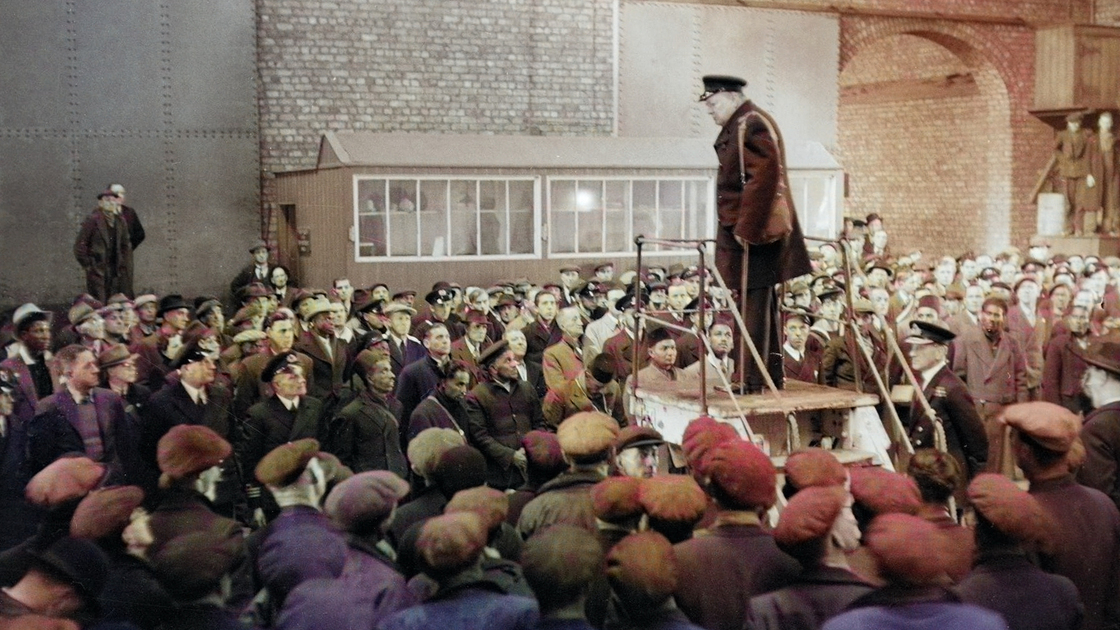
Churchill’s oratory during the Second World War was the pinnacle of the English language. His wartime speeches are unequalled masterpieces of how words can be orchestrated to convey thoughts that transcend time and space. Over 80 years later, they still reach out and grab the heart, inspiring it by the courage, defiance, and vision that spring to life.
Many historians agree it is the highest formation of English and that it will probably never be bested. Even writers who began their careers hostile to Churchill’s legacy, such as Paul Johnson, were converted by listening to Churchill’s wartime speeches.
Churchill is dead, but his words continue to live in us today.
What makes them more astounding is that they were crafted under the extreme stress and tension of world war, in compressed windows of time. What made it possible for Churchill to rise to this occasion was his life-long education and dedication to master the English language.
The perfect product of Churchill’s wartime speeches was the result of his pursuit of perfection. This was Churchill’s ambition from a young age, and he took advantage of every single opportunity to grow and improve his ability to write and speak. By the time he became prime minister in 1940, he had been a member of Parliament for 40 years. It was a 40-year pursuit of perfection that prepared him for that great trial.
In October 1929, Churchill gave a speech to his constituency in which he crafted the “disarmament fable,” a colorful analogy of animals meeting in the forest to discuss how to have peace through disarming themselves of their claws or teeth. However, the lesson was that the animals would only disarm if the other animals would give up their teeth and claws first!
Following the speech, many sent Churchill congratulations on what they considered his best speech yet. “I have been green with envy for two days because I never thought of the zoo allegory,” Stanley Baldwin wrote. “It is just perfect, and there is no more to be said.”
Following a budget speech Churchill gave as chancellor of exchequer, a fellow MP called it “ a masterpiece, and about the best I have ever heard” and said he considered him “head and shoulders above anyone else in the House” in “both oratorical and debating skill, at the present moment.”
After a three-hour speech Churchill gave in the late 1920s, Neville Chamberlain wrote in his diary that the speech “was one of the best he has made and kept the House fascinated and enthralled by its wit, audacity, adroitness and power.”
Baldwin again wrote to Churchill after the same speech: “I have never heard you speak better, and that’s saying a good deal.”
During the wilderness years, Churchill continued to perfect his craft, despite not receiving any reward or credit from members of the government, who continually attacked him. The media censored him, but his oratory continued to have an impact.
Following a speech about the dangers of German rearmament, Clive Morrison-Bell wrote to Churchill: “It is quite one of your best, I think. You are so right about not being mealy-mouthed just now; the tone everywhere is far too apologetic, and you seem to be almost the only person who ever speaks out.”
On April 14, 1937, Churchill made a powerful speech predicting that the policy of appeasement was pushing the world toward war: “We seem to be moving, drifting, steadily, against our will, against the will of every race and every people and every class, towards some hideous catastrophe. Everybody wishes to stop it, but they do not know how.”
Even his critics recognized this speech “as being of great merit,” writes Martin Gilbert, who quoted one of those critics as calling it, in his diary: “a terrific speech, brilliant, convincing, unanswerable and his ‘stock’ has soared, and today people are … saying once more that he ought to be in the government, and that it is too bad to keep so brilliant a man out of office …”
Anthony Eden wrote to Churchill after the same speech: “May I also say how very good I thought your speech as a whole; indeed I heard many opinions that the speech must be ranked among your very best.”
During fiery debates over Germany during the summer, Lord Melchett wrote to Churchill: “One of your best ever.”
One of Churchill’s closest friends, Robert Boothby, told him it was “the best speech I have ever heard in the House of Commons. There was nothing more to be said.”
Churchill was never satisfied with anything he wrote until he thought it was perfect. He would roll around words in his mouth, musing over their sounds and meaning, like a chef tasting his dish, looking for the perfect combination. He would spend many hours on each speech (when possible), constantly redrafting until he thought it was perfect.
The 40 years of relentless work toward perfection resulted in the masterpiece of May 13, 1940. “I would say to the House, as I said to those who have joined this government: I have nothing to offer but blood, toil, tears and sweat …” he said. “You ask, what is our policy? I can say: It is to wage war, by sea, land and air, with all our might and with all the strength that God can give us …. That is our policy. You ask, what is our aim? I can answer in one word: It is victory, victory at all costs, victory in spite of all terror, victory, however long and hard the road may be; for without victory, there is no survival.”
As the British Expeditionary Force was on the brink of disaster at Dunkirk, Churchill rallied the nation on June 4, 1940: “We shall go on to the end, we shall fight in France, we shall fight on the seas and oceans, we shall fight with growing confidence and growing strength in the air, we shall defend our Island, whatever the cost may be, we shall fight on the beaches, we shall fight on the landing grounds, we shall fight in the fields and in the streets, we shall fight in the hills; we shall never surrender.”
Following the fall of France, in the darkest moment of the war, Churchill said on June 18, 1940: “Let us therefore brace ourselves to our duties, and so bear ourselves that, if the British Empire and its Commonwealth last for a thousand years, men will still say, ‘This was their finest hour.’”
One man’s pursuit of perfection was used to save Western civilization. Nothing less would have sufficed: The only path to victory lay on the path to perfection.
The pursuit of perfection is the calling of a true Christian. In the Sermon on the Mount, Christ gave us the overall mission of our lives: “Be ye therefore perfect, even as your Father which is in heaven is perfect” (Matthew 5:48).
Churchill strove for perfection in language, but God wants us to strive for a much nobler goal: the pursuit if perfect godly character! “The determination to reach perfection is a remarkable quality,” writes Philadelphia Church of God Pastor General Gerald Flurry in the January 2012 Trumpet magazine. After quoting Matthew 5:48, he writes: “It really encapsulates the gospel of God! It is all about human beings actually becoming like God Himself! God is a perfectionist! Being a perfectionist is a godly quality—which is why it works …. Christ challenges us to apply it in the areas of our life that really matter most!”
We can apply the pursuit of perfection to everything we do, but especially where it matters most: our character. We are all flawed human beings. We all fall short and experience failure at times. Yet we must remember perfection is a process. We must seek every opportunity to become more perfect; it will not happen all at once. We must not become discouraged with where we are, but be ambitious to grow! Perfection is possible only through using God’s Holy Spirit (Matthew 19:26).
“How much of a perfectionist are you?”, continues Mr. Flurry, “Do you strive for the perfect marriage, the perfect children? Do you labor to produce the most perfect product possible at work? If we do this, good things will happen. God tells us to develop that quest for perfection in everything we do!”
Build the perfectionist mindset into everything you do. All who enter into the Kingdom of God will have become perfect. Just as we remember Churchill’s wartime oratory as monuments to perfection, the Philadelphians will stand as pillars in Jerusalem (Revelation 3:12), our lives as monuments to God’s path of perfection, examples that perfection is possible when we pursue it every day with the power of God.