
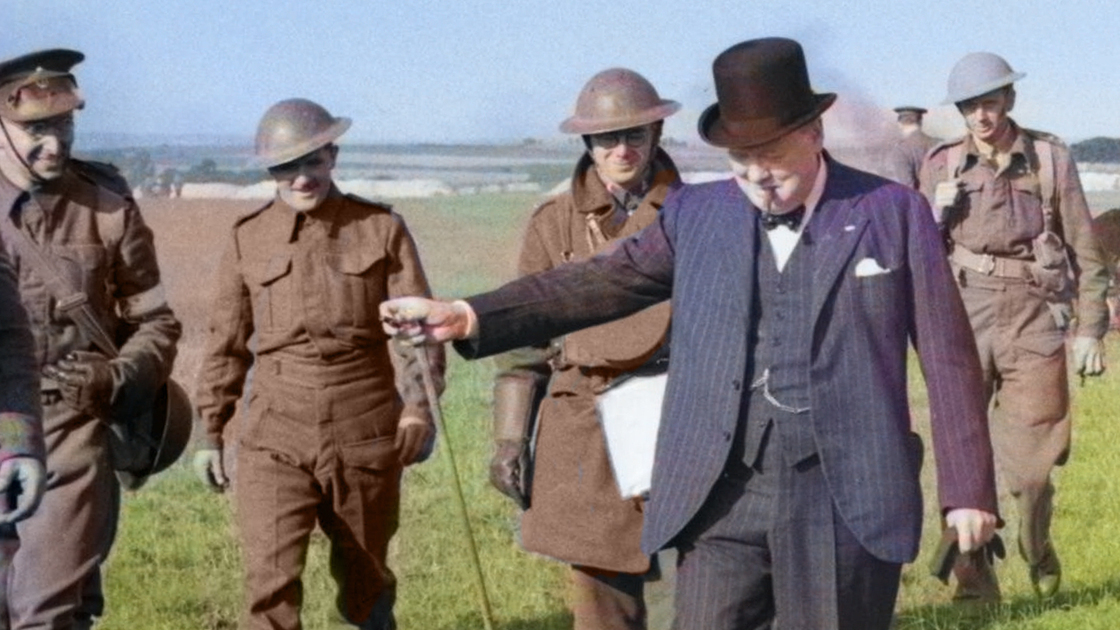
At seven o’clock in the morning on May 15, 1940, Churchill was roused from sleep by a telephone call from the president of France. The Germans had broken through the battlefront at the French town of Sedan, and the road to Paris appeared completely open. President Paul Reynaud was panicked and talking of giving up. Churchill listened and encouraged his friend not to be led astray by early news, to consider the broader picture and the true facts. President Reynaud felt much more resolved and heartened after speaking to Churchill.
This story reveals one of Churchill immense qualities: He was a masterful encourager. Through his everyday interactions, displays of emotion, and infectious resolve, every individual who was around him felt inspired and encouraged!
While much emphasis is put on Churchill’s wartime speeches and broadcasts, and rightfully so (as we will examine in the next installment), it was his day-to-day example and encouragement that kept the British war effort moving toward victory.
One key to effective leadership is the willingness to be vulnerable—not just in the sense of being physically vulnerable on the battlefield. The greatest way Churchill was vulnerable was the moral courage to express his emotions, his inner thinking, and declare the truth regardless of opposition or consequences. It was from this fountain of courage that the British people drank. Unless Churchill poured forth his heart, his passion, his righteous zeal for the cause, there would have been no inspiration.
This was exceptionally rare in the age and environment in which Churchill lived. “The concept of the British stiff upper lip was invented by the Victorians,” writes historian Andrew Roberts. “It was widely believed that the British Empire itself depended on the capacity of officers and gentlemen to rise above their natural human emotions and stay calm and collected, regardless of whatever appalling thing was happening.” He was “a man of such powerful emotions, with a profoundly romantic imagination and capacity for empathy, and also possessing such aristocratic disregard of what others thought of him, that if he felt like crying, he just did. Such was his historical imagination too that this astonishing lachrymosity could be unleashed at minor moments as well as on great occasions….”
Churchill was profoundly different because he so openly shared his emotions; he defied the spirit of the age and moved the nation. This quality enabled Churchill to be the great encourager and motivator.
Many individuals throughout the war recalled moments when Churchill’s displays of emotion moved them and inspired them more than any speech could. Roberts recounts stories of Churchill’s lachrymosity in the article “Winston Wept.”
When the wilderness years ended and Churchill returned to the Admiralty, his energy and example were infectious. Director of the Trade Division G.R.G. Allen recounted: “One thing that remains firmly in my mind about Winston’s arrival in the Admiralty was the immediate impact which his personality made on the staff at all levels, both service and civilian.”
Clifford Jarrett, a secretary, said he “inspired people to extreme devotion. Churchill’s supreme talent was his ability to speak to people.”
John Higham said Churchill was “a tremendous tonic” to the Admiralty.
“The inspiration of Churchill’s character and concern was felt by all his staff,” writes Martin Gilbert in Finest Hour. “‘When Winston was at the Admiralty,’ his secretary Kathleen Hill later recalled, ‘the place was buzzing with atmosphere, with electricity. When he was away, on tour, it was dead, dead, dead.’”
Churchill had an unusual schedule, but it was a rigorous. He demanded that others have the same work ethic and did ask them for many sacrifices. Oftentimes Churchill could be impatient, selfish and rude, usually exacerbated by the strain of responsibility. However, Churchill never forgot to display gratitude and a fatherly concern for his staff. “Nor was their master oblivious of the strain which he, and events, put upon them,” continues Gilbert, “‘The PM gave me such a kind and human goodnight,’ John Martin wrote home, ‘when he went up to bed at 1 o’clock this morning—put his hand on my arm and said he was sorry there had been no time in all the rush of these days to get to know me.’”
Whether it was a statesman, a general, a soldier, a factory worker or a widow, Churchill was always willing to take the time to encourage them. Despite being an aristocrat, his vast life experience taught him how to be all things to all men, and he was never afraid to display emotion, and he also handled the emotions of others with magnanimity.
In many ways, the fate of the British Empire and Western civilization hinged on how Churchill lived every day. His example and encouragement changed the course of history.
This provides some tremendous lessons for us as true Christians today. The Bible speaks often about encouraging and helping others (1 Thessalonians 5:11; Romans 12:8). It is filled with examples that inspire us, words that encourage us, and promises where God exhorts us to never give up the good fight of faith.
Can you and I be encouragers? Does our day-to-day example inspire others? Do we tend to bring people down with negativity and anxiety, or do we leave others positive and uplifted?
When your friends, spouse, or children face difficult times or problems, can you provide them real encouragement? Do we inspire those closest to us to greater action through how we live?
Just as Churchill had an inner moral courage and clarity that allowed him to share his emotions and convictions with others through word and deed, we must strive to share Christ living in us with others (Galatians 2:20)! If we have God’s Spirit dwelling in us, which is God’s nature, emotions and resolve, then we must learn how to share that hope with others: “But sanctify the Lord God in your hearts: and be ready always to give an answer to every man that asketh you a reason of the hope that is in you with meekness and fear” (1 Peter 3:15).
This is primarily achieved through our example. We do not often give speeches to others, but often sincere words of encouragement inspired from the Bible—sharing your own feelings and convictions—mean more to someone than a perfectly worded sentence. Churchill was a master of connecting with people through emotion: We must learn how to connect with others through godly emotion.
In his book The Psalms of David and the Psalter of Tara, Pastor General Gerald Flurry points to the example of King David being a man after God’s own heart (Acts 13:22). David is an outstanding example of a man who shared his passions, his emotions and his inner most thoughts with us! They are recorded in the scriptures to teach us how to use emotions and passion to encourage others.
In many ways the impact of God’s Church depends on how we live every single day. Our example and encouragement can change the course of someone’s life!
This is something you can strive to do daily. Learn to be an infectious encourager like Churchill, and let your light shine. As Matthew 5:16 reads: “Let your light so shine before men, that they may see your good works, and glorify your Fathe