
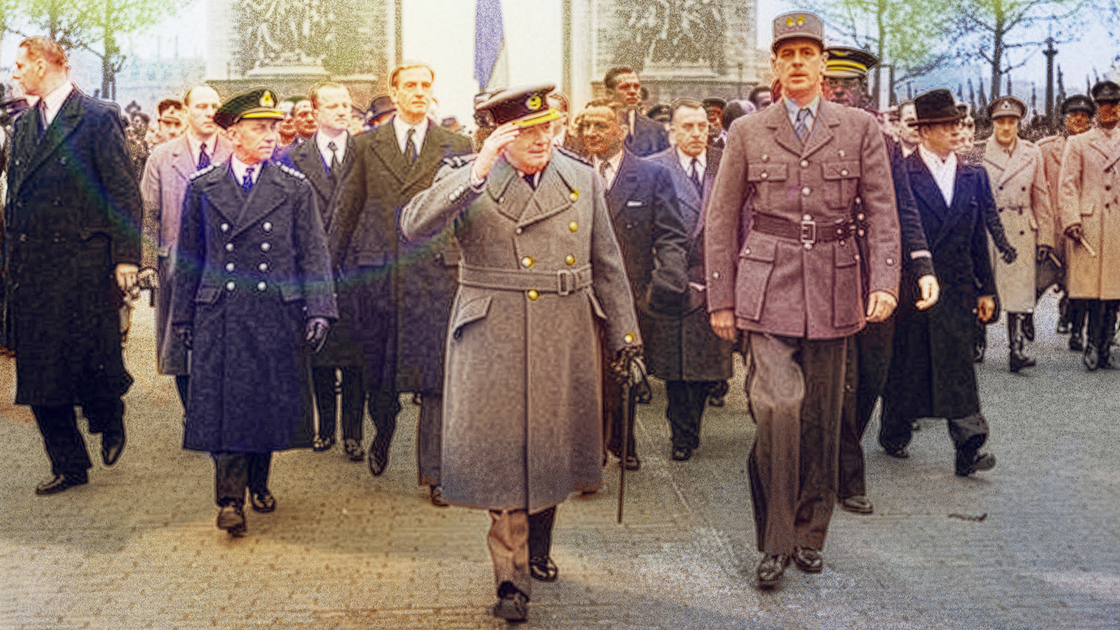
In Volume 6 of Martin Gilbert’s biography of Winston Churchill, Finest Hour, is a letter from Gen. Hastings Ismay to Gen. Claude Auchinleck, dated Aug. 2, 1941, describing Churchill’s character as a war leader.
“Churchill could not be judged by ordinary standards; he was different from anyone we had ever met before, or were ever likely to meet again,” Ismay wrote. “… His courage, enthusiasm and industry were boundless, and his loyalty was absolute. No commander who engaged the enemy need ever fear that he would not be supported.”
Later in this letter, General Ismay made this extraordinary statement: “His whole heart and soul were in the battle, and he was an apostle of the offensive” (emphasis mine throughout).
An apostle of the offensive. The more I think about that phrase, the more I realize how perfectly it describes what God requires of His people today.
God’s faithful remnant Church in this Laodicean era is led by an apostle—and from the beginning, this whole Work has been about fighting our spiritual warfare on the offensive.
That man must be “an apostle of the offensive”! But that is not just a phrase for one man. It is a commission for all of us. God wants an apostle who is on the offensive—and that means all of us are on the offensive. God wants us to go into this world with a powerful message from God Himself. That is what this Work is about.
Prophesy Again
Herbert W. Armstrong fulfilled this commission: “And this gospel of the kingdom shall be preached in all the world for a witness unto all nations; and then shall the end come” (Matthew 24:14). All the world! All nations! Do you grasp the size of that commission? This is a witness to all nations. God wants every person on Earth to have access to this message!
Mr. Armstrong truly was an apostle of the offensive. You have to be to fulfill that spiritual office, especially in this evil world.
Revelation 10:11 gives us our God-given commission in this Laodicean era: “… Thou must prophesy again before many peoples, and nations, and tongues, and kings.” (For a thorough explanation of this verse, request a free copy of our booklet Prophesy Again.)
Mr. Armstrong went out and prophesied to this world with everything he had. Now God tells us, Do it again. Get back out there with that same message, and reach many peoples and nations—the largest audience possible. That is what the Philadelphia Church of God has been striving to do since we started in 1989.
In addition, I have written some 70 books and booklets, nearly all of them containing new revelation from God. God would only do that through the office of an apostle (Ephesians 3:5). That is an astonishing body of truth to get into the hands of a suffering world.
God wants every person on Earth to hear this message! And to do that, you must be on the offensive. You cannot sit back and wait for people to come to you. You have to go to them. You have to drive yourself and push and fight!
Churchill said, “The offensive is three or four times as hard as passively enduring from day to day. It therefore requires all possible help in early stages.” Taking that first big step out is enormously difficult!
He continued, “Nothing is easier than to smother it in the cradle. Yet here perhaps lies safety.” If you want to be safe, go on the offensive. That sounds counterintuitive. But Churchill knew it to be true—and God does too.
The word offensive means aggressive action, going on the attack. That is what God is asking from His people—not passive endurance or cautious maintenance of what we already have, but aggressive, forward-moving proclamation of His truth!
We are here to reach the largest audience possible with the greatest message ever delivered to this world. That takes money, effort and sacrifice. It takes the heart and soul of people who refuse to back down. God doesn’t want people who simply hold their ground. He wants soldiers who take ground!
A War Leader Without Equal
General Ismay also said about Churchill: “He was head and shoulders above anyone that the British or any other nation could produce. He was indispensable and completely irreplaceable.”
A great leader makes it possible for everyone around him to rise to a higher level. He provides vision when there is none. He supplies courage when fear would otherwise prevail.
Ismay continued: “His knowledge of military history was encyclopedic, and his grasp of the broad sweep of strategy unrivaled.” Churchill spent a lifetime studying war—reading about it, writing about it, living it. The result was a mind that could see the whole battlefield when others saw only the ground beneath their feet. “He had a considerable respect for the trained military mind,” Ismay said, “but refused to subscribe to the idea that generals were infallible or had any monopoly of the military art.”
Churchill often quoted Adm. Horatio Nelson’s Trafalgar Memorandum: “No captain can do very wrong if he places his ship alongside that of an enemy.” Do not maneuver endlessly, he was saying. Do not hesitate—get into the fight! Close the distance with the enemy. Pull your ship right up next to him! Engage!
Churchill took that lesson to heart. His whole heart and soul were in the battle. When others counseled patience, Churchill pushed, prodded and demanded action.
“The idea that he was rude, arrogant and self-seeking was entirely wrong,” Ismay wrote. “He was none of these things. He was certainly frank in speech and writing, but he expected others to be equally frank with him. To a young brigadier from Middle East Headquarters, who had asked if he might speak freely, he replied: ‘Of course. We are not here to pay each other compliments!’” Churchill wanted truth. He wanted to know the real state of the war—not flattery, not comfortable assessments, but truth.
God wants the same from us. He wants people who are willing to face reality, who will not soften the message to make it more palatable, who will tell this world exactly what it needs to hear. That is what a prophet and a watchman does. He does not soften the warning to spare feelings—he delivers it because lives depend on it! That is what it takes to prophesy again! That requires going on the offensive.
“Apostle of the offensive” is so appropriate for our work. That is one of the most inspiring statements, or titles, I have ever heard.
The Watchman’s Responsibility
Here is another commission from God we must carry out: “So thou, O son of man, I have set thee a watchman unto the house of Israel; therefore thou shalt hear the word at my mouth, and warn them from me” (Ezekiel 33:7).
This is no small assignment! The watchman has been set on the wall by God Himself. His job is to see what is coming, to hear the word from God’s mouth, and to warn the people. Not to suggest, or gently hint, but to “warn them from me.”
God continues: “When I say unto the wicked, O wicked man, thou shalt surely die; if thou dost not speak to warn the wicked from his way, that wicked man shall die in his iniquity; but his blood will I require at thine hand” (verse 8). If the watchman fails to warn, the blood is on his hands. That is how seriously God takes this commission!
“Nevertheless, if thou warn the wicked of his way to turn from it; if he do not turn from his way, he shall die in his iniquity; but thou hast delivered thy soul” (verse 9). Even if people do not listen, we have done our job. That is all we can do. But we must do it. God will not overlook it if we remain silent!
“Say unto them, As I live, saith the Lord God, I have no pleasure in the death of the wicked; but that the wicked turn from his way and live: turn ye, turn ye from your evil ways; for why will ye die, O house of Israel?” (verse 11). Turn and live! That is God’s message to this world. Repent! Change. They do not like to hear that, but it is what they need to hear.
Look at how God frames it: Why will ye die? He is pleading with them to turn. But He is also clear: If they do not turn, they will die in their iniquity. The love of God and the justice of God are not in conflict—and the watchman has to deliver both sides of that message. It is not enough to tell people God loves them—we also have to tell them what God requires. That is the full message.
This prophecy concludes: “And when this cometh to pass, (lo, it will come,) then shall they know that a prophet hath been among them” (verse 33). Here we see that this watchman was also a prophet! When all is said and done, when the prophecies have been fulfilled, the people of this world—the house of Israel in particular—are going to look back and know a prophet was among them. It was a voice sent by God, and they did not listen. In the end, this Work will be vindicated.
The fruits are there; the witness is going out. But we need to do all we can to make sure they know the message from this prophet was sent by God! They won’t know that unless we get the message out. And the only way that can happen is if we go on the offensive.
Gideon’s Army
In the days of the judges, Israel was under attack from the Midianites, and God raised up Gideon to deliver them. Gideon assembled an army, but God told him, “The people that are with thee are too many …” (Judges 7:2).
God instructed Gideon to tell the people, “Whosoever is fearful and afraid, let him return and depart early from mount Gilead.” Of the 32,000 soldiers, 22,000 accepted Gideon’s invitation to leave (verse 3). Those men were afraid, and God said, Go. I do not want you here.
This is a remarkable passage. God had an army, and He dismissed most of it because they were fearful. He did not try to encourage them and build them up. He sent them home. That is how God feels about fear in His soldiers.
God said the 10,000 who remained were still too many. So He had Gideon put them to a test: He had them go to a pool to drink water and told Gideon to dismiss any soldiers who got on their knees to drink—to only keep those who remained vigilant, ready to fight, even when drinking, who simply crouched down on their feet and brought the water to their lips with their hand.
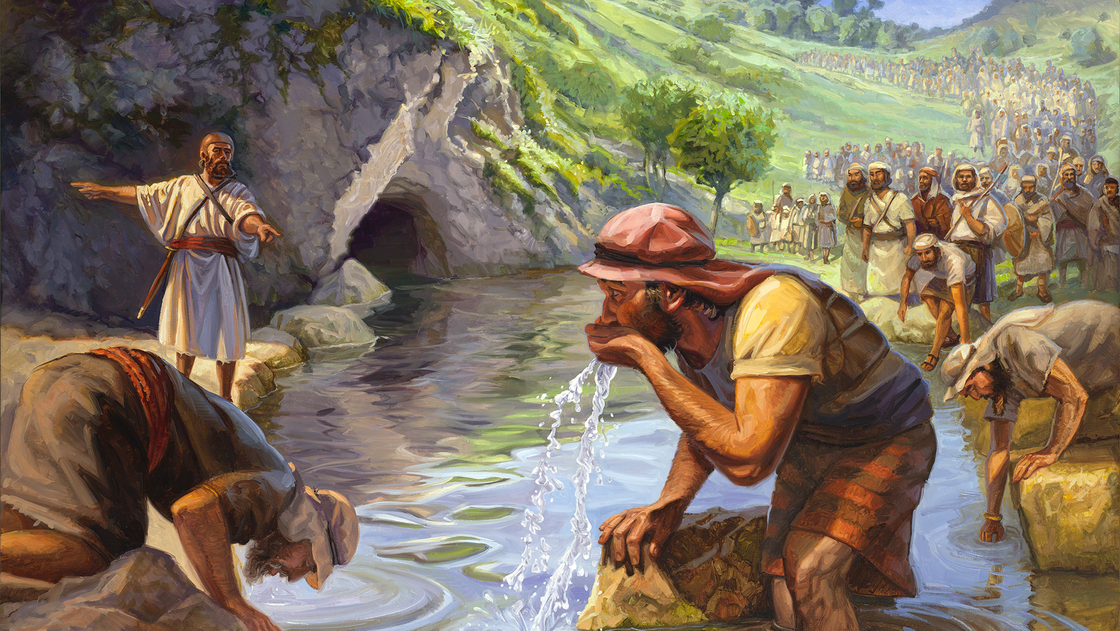
Only 300 of the men passed this test (verse 6). Three hundred men were so eager for battle, they would not even kneel down at the water. They lapped it from their hands and remained ready to fight. God chose those men because lapping the water was a window into their character: they were men who were thinking about the fight. Those were God’s offensive-minded soldiers.
“And the Lord said unto Gideon, By the three hundred men that lapped will I save you, and deliver the Midianites into thine hand: and let all the other people go every man unto his place” (verse 7). Three hundred men is all God needed. Those 300 were not afraid. They were ready to fight. They knew God was behind them, and that was enough.
If you are not eager to fight, you will lose crucial battles. We cannot do battle halfheartedly. Churchill said the great principle of going on the offensive is being wholehearted. If you go onto the battlefield half-committed, you will hesitate—and when you hesitate, you lose, physically and spiritually.
Those men who bowed down to drink were not necessarily cowards. They may have been good fighters. But they were not hungry enough or urgent enough. They had mentally allowed a moment of ease before the battle. God noticed and sent them back.
How do you approach the Work? Are you urgent and hungry? Or have you allowed yourself a comfortable distance from the battle? God is looking for people who are eager to do battle and go on the offensive. That has to be us. We are right in the battle! We do not have the luxury of kneeling down and resting when there is a war to fight.
McClellan’s Mistake
The Civil War offers a sobering example of the opposite. At the Battle of Antietam, Gen. George McClellan had about 180,000 men on the army rolls. Of these, 70,000 were “absent on leave,” which had been granted by company officers. President Abraham Lincoln remarked that if those men had been present, McClellan could have surrounded Lee, captured the entire Rebel Army, and ended the war in a single stroke! But they were absent, so the war dragged on.
Shamefully, there were 7,300 desertions a month in the Civil War! And McClellan was granting leave on top of that, which, according to Lincoln, was almost as bad as desertion.
General McClellan’s problem was not lack of knowledge—it was lack of fight. He loved his men so much he did not want to lead them into battle! He put them above the cause.
The result was a war that lasted far longer than it should have, costing far more lives than necessary. Misplaced compassion is a terrible failure of leadership.
McClellan thought he could win the war with mere strategy. But strategy without action wins nothing! You must fight. Only then does the strategy matter.
God is making generals! We are going to sit on David’s throne with Jesus Christ as kings and priests! We must be preparing for that responsibility now, in the way we live, fight, give and sacrifice.
The Armor of God
God’s people do not fight on a physical battlefield, but our warfare is just as real. “For we wrestle not against flesh and blood, but against principalities, against powers, against the rulers of the darkness of this world, against spiritual wickedness in high places” (Ephesians 6:12).
We have to battle and overcome “spiritual wickedness in high places.” This is fierce warfare against the rulers of the darkness of this world—Satan and his demons!
Paul knew this firsthand. He was beaten, shipwrecked, imprisoned and, ultimately, executed—not because of anything he did wrong, but because he was on the offensive for God in a world ruled by Satan. He did not pull back or soften the message—he pushed harder! From prison he wrote some of the most powerful letters in the entire Bible! He truly was “an apostle of the offensive”!
“Wherefore take unto you the whole armour of God, that ye may be able to withstand in the evil day, and having done all, to stand” (verse 13). Do not collapse or retreat. Do not abandon the field. Stand!
“Stand therefore, having your loins girt about with truth, and having on the breastplate of righteousness; And your feet shod with the preparation of the gospel of peace; Above all, taking the shield of faith, wherewith ye shall be able to quench all the fiery darts of the wicked” (verses 14-16). Every piece of this armor is critical: truth, righteousness, the work of the gospel, faith. With the shield of faith, you can deflect every dart Satan hurls at you—every attack, doubt and discouragement!
“And take the helmet of salvation, and the sword of the Spirit, which is the word of God” (verse 17). Most of the armor is defensive. But the sword of the Spirit is an offensive weapon! God gives you a sword so you can go on the offensive! That is what it is for. You need to study your Bible deeply. Know the doctrines of God. Use that precious truth to guide your decision-making. Apply what you read in the Scriptures. That will ensure you have that belt of truth, that breastplate of righteousness, that shield of faith. Get out there and use that offensive weapon!
Think about the picture Paul is painting. You are standing on a battlefield—fully armored, shield raised, sword in hand. That is not a picture of someone hiding. That is a soldier—and soldiers fight! God doesn’t give His armor to people who intend to sit in a corner waiting for Christ to return. He gives it to people who intend to engage—who are going to take that sword of the Spirit, the Word of God, and use it to reach a lost and dying world.
Paul continues, “Praying always with all prayer and supplication in the Spirit, and watching thereunto with all perseverance and supplication for all saints; And for me …” (verses 18-19). Pray always, for one another and for God’s ministry. I really need your prayers. I am 91 years old now and haven’t had a lot of energy lately. A big reason I am able to keep working is because of your prayers. We do need to pray for each other. And our prayers ought to really mean something! Every one of us ought to have prayers that have an impact. Do not underestimate what your prayers accomplish when you pray in the Spirit for me, for God’s ministers, for His Work and for each other.
Paul went on: “For which I am an ambassador in bonds: that therein I may speak boldly, as I ought to speak” (verse 20). Paul was not in prison for keeping his mouth shut. He went to prison because he was speaking boldly for God! And even in prison, Paul wanted to be all the more bold! From his prison cell, he went on the offensive. He wrote letters, taught and exhorted. The Word of God was not bound, even when Paul was!
What a marvelous example this man set of offensive warfare.
The Philadelphia Church of God was founded on Dec. 7, 1989, when two men were fired and disfellowshiped from the Worldwide Church of God for refusing to compromise with God’s truth. That is the foundation this Work stands on—an absolute refusal to let go of the truth God gave through Mr. Armstrong.
That spirit must continue. Being part of this faithful-remnant Church requires every person to make that same commitment: I will not compromise. I will not back down. I will hold fast to God’s truth no matter the cost.
Speak Boldly
Paul wrote to Timothy: “Thou therefore, my son, be strong in the grace that is in Christ Jesus” (2 Timothy 2:1). God wants us to be strong! We gain that strength not from ourselves but from Christ. And with that strength, we go on the offensive.
“And the things that thou hast heard of me among many witnesses, the same commit thou to faithful men, who shall be able to teach others also” (verse 2). Paul wanted more teachers, more people who could carry the message forward. That is the multiplying effect of the offensive: One faithful person teaches another, who teaches another, and the message spreads.
“No man that warreth entangleth himself with the affairs of this life; that he may please him who hath chosen him to be a soldier” (verse 4). We are soldiers. And we are not here to please ourselves or to be comfortable. We are here to please the one who chose us.
“It is a faithful saying: For if we be dead with him, we shall also live with him: If we suffer, we shall also reign with him: if we deny him, he also will deny us” (verses 11-12). God promises that if we suffer, we shall also reign with him. The suffering and the reigning go together. You cannot have the crown without the fight.
Paul was at the end of his life when he wrote this epistle. He concluded it with this devastating statement: “At my first answer no man stood with me, but all men forsook me: I pray God that it may not be laid to their charge” (2 Timothy 4:16). All men forsook him! What a terrible indictment of these people. Here was an apostle giving everything for God, going on the offensive from prison, and his own people abandoned him.
What a lonely moment that must have been! The man who had given his entire life to the Work of God, who had been beaten, imprisoned and shipwrecked in its service, was standing at his final defense—with nobody beside him. All men forsook me. Yet Paul did not grow discouraged or bitter. He said, I pray God that it may not be laid to their charge. That is the character of someone who has truly internalized the spirit of the offensive, fighting for God and even fighting for the people who let him down.
That is the spirit God is building in us. We must not make the mistake of those who abandoned Paul. We must be among the 300 who lap the water from our hands and keep running. Soldiers who conquer our fear to remain in the fight—who place our ships right alongside the enemy!
The house of Israel and the whole world will know that a prophet was among them. When they look back at this time, they are going to see what God built here through an apostle and through a people who refused to back down.
In the end, our reward—sitting on David’s throne with Jesus Christ, ruling the Earth and then the universe—is worth every battle we will ever fight.