
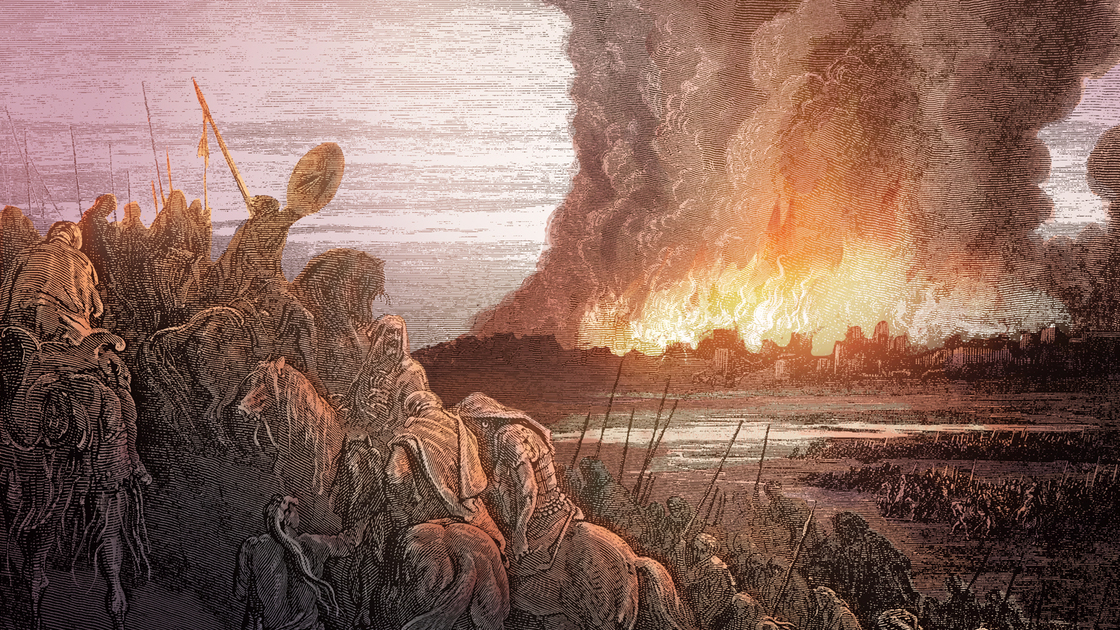
“Give God victories” is a rallying cry Pastor General Gerald Flurry has given us in recent years. Perhaps the most victorious warrior in the Bible is Joshua. He led Israel into the Promised Land, achieved spectacular, miraculous triumphs in battle, and conquered 31 kings. God recorded this man’s life for us in dramatic detail. We need to follow Joshua’s example and give God victories.
Joshua has a special place in the Philadelphia Church of God’s history. Mr. Flurry wrote much about him in his first book, Malachi’s Message. The man God had used to lead His true Church, Herbert W. Armstrong, had died, and his successors waged a spiritual attack. “The Joshua story tells us how to lead when a great man like Moses dies,” Mr. Flurry writes. “By studying this example, the leaders in Pasadena would have known how to lead—and how not to lead—when Mr. Armstrong died, and the consequences of each. That makes these books very prophetic!”
Long after Moses had died and Joshua had been in charge for years, Joshua kept Moses alive in the Israelites’ eyes. Mr. Flurry has followed that example in an extraordinary way. God began using Mr. Flurry to lead His true Church when he was 54 years old. In the decades since, he has stood up to the deceit of treasonous church leaders, fought for the truth, and raised up one ruin after another from the Work of God that had been destroyed. He continues working, fighting and pointing to Mr. Armstrong and to the God of Mr. Armstrong on into his 90s. In the spiritual realm, Mr. Flurry is a Joshua-like figure: loyal, obedient, faithful, uncompromising, willing to fight.
Strength and Courage
Joshua was born a slave. His early life was shaped by oppression, threats, deprivation and bondage. For obvious reasons, slaves have subservient, fearful mindsets. Yet something special existed in the mind of this son of Nun. We are introduced to it as the Bible first introduces us to him.
“Then came Amalek, and fought with Israel in Rephidim. And Moses said unto Joshua, Choose us out men, and go out, fight with Amalek …” (Exodus 17:8-9). Shortly after their departure from slavery, this throng of newly freed slaves faced an attacking army, and Moses delegated the life-and-death physical defense of millions of people to Joshua. This young man, in his late 20s to mid-30s, must have already stood out among men because of his mindset, his spirit, his character. He did not have the mindset of a slave but of a captain!
Israel’s men lacked the weapons and training to withstand this coming army. But Joshua was well armed with the memory of what he had witnessed weeks before. God had struck Egypt with miraculous plagues and protected the Israelites. He had delivered His people and led the march by a pillar of cloud and fire. Others forgot those miracles—but not Joshua.
Commanded by Moses, he responded with a “yes, sir” attitude.
He mustered men, scrounged weapons, made formations, and gave orders. Among a people prone to murmuring, this man of action commanded respect.
God was with Israel, but He allowed the Amalekites to attack and engage. The men of Israel had to fight. Above the melee, Moses appealed to and lifted his arms to God. And on the ground, amid the thrusts and slashing and cries of battle, the soldiers experienced the difference—pressing forward as the human leader of Israel raised his arms to the spiritual Leader, falling backward as his arms fell from exhaustion (verses 9-11). Aaron and Hur upheld Moses’s hands, and Joshua prevailed against Amalek (verses 12-16).
What a powerful lesson this was for Joshua: He learned to lead by action, he learned war by fighting, he learned to look to God’s government, and he learned to win by drawing strength from God and taking the victory.
God shapes warriors through war. He sometimes shields us from hardships we cannot handle (Exodus 13:17). Yet He often drops us into hardships we think we cannot handle but can with His help (1 Corinthians 10:13). In those challenges, we need to study and believe, then act on that faith. We all need
challenges and difficulties: That is the only way to trust God and give Him victories!
Faith in Adversity
God saw to Joshua’s training through tests and experience and through Moses’s direct teaching. Joshua soaked up those experiences. He was with Moses during key events, like ascending Mount Sinai (Exodus 24:13). He saw God’s government in action. He was trained in God’s law. God had a leadership position in mind for Joshua—as He does for you, and He is shaping your experiences.
When Israel reached the Promised Land, Moses sent this young man as one of 12 spies. The spies returned with high praise for the land but a fearful, “evil report” of its inhabitants (Numbers 13:32-33). Joshua and Caleb had seen these same inhabitants and other obstacles, but they reacted with faith. In an inspiring speech, they spoke of eagerly meeting those threats and hardships with God’s help (Numbers 14:6-9). This is the positive, passionate, faith-filled attitude we need for spiritual victories.
The faithless people wanted to stone Joshua and Caleb for speaking out (verse 10). But these two men obeyed God’s law that we not fear the face of man (Deuteronomy 1:17). Still, God decided the faithless nation must wait 40 years to enter the Promised Land. Watching that reward slip away and accepting that decision would have been tough for Joshua, but he did not let it ruin him. That adversity forged him into an even stronger leader—one who could succeed Moses and finally lead the people into Canaan.
Even after Moses died, Joshua was “Moses’ minister” (Joshua 1:1). In a sense, Joshua fulfilled that role until he himself died nearly four decades later!
God’s Advice to Warriors
The book of Joshua, documenting the conquest of Canaan, begins when Joshua is an old man—probably in his 70s! This man knew how to push himself and to rely on God for strength. Even as an old man, he gave God many victories! The lessons we can take from him apply to all of us, old and young.
In Joshua 1, God instructed him on how to achieve victories. He didn’t teach him battle tactics, formations, strategy, weapons, rigorous physical training to endure combat demands, mental exercises to build resilience, critical thinking, stress management, skills in intelligence gathering, or logistics and resource management. What God taught him, more than anything else, was faith.
God directed the whole operation. He told Joshua where to go and what to do, and He said: “… I will be with thee: I will not fail thee, nor forsake thee” (verse 5).
“Only be thou strong and very [or wholly] courageous, that thou mayest observe to do according to all the law, which Moses my servant commanded thee …” (verse 7). These precious verses are God’s direct instruction to a warrior on how to fight and win victories! We must be all in, fighting heart and soul. Action goes a long way! (Matthew 11:12).
It takes courage to obey God and to follow every word of the instructions from God’s man. But this is how to achieve victory: Don’t deviate from those instructions. Make sure every step is in line with that standard God has established. We naturally think we have a better way. It is especially easy to think that when the person you have to submit to is dead! But God said, No! Those instructions came from me—and I’m still here! Obey them, and you will prosper and gain victories. Mr. Flurry is an excellent example. To this day, in addition to consulting God and His Word, he continually asks, How did Mr. Armstrong handle this?
Joshua was a strong warrior, yet God warned him not to be timid or discouraged (Joshua 1:9). He knew that conquering the Promised Land would be hard. Our natural response to trial is fear and dismay. But remember: “the Lord thy God is with thee.” That makes life, even when challenging, meaningful and exhilarating! God wants our whole life to be a challenging, strengthening, inspiring struggle—rewarding warfare, a good fight, leading into the Promised Land!
“Joshua’s book shows why he won battle after battle going into the Promised Land—how he was able to defeat 31 kings and finish his job,” Mr. Flurry writes. “Above all, it shows how he exalted God. This is the only way for us to reach the Promised Land, God’s Kingdom!” (The Former Prophets). That is key: Exalt God, and you will win your battles.
Put God First
When the Israelites crossed the Jordan River into the Promised Land, Joshua ordered them to follow the ark of the covenant and to “go after it” (Joshua 3:3). He was teaching the people the key to victory: Follow God. Joshua didn’t put the best warriors in front—he put the ark, the symbol of God’s throne and God’s presence, up front.
The most important word in the phrase “give God victories” is God. We need Him to lead us in battle.
“Joshua loved working for God. He knew that when you truly serve God, God works wonderful miracles for you,” Mr. Flurry writes. “Joshua called Him ‘the living God [who] is among you’ (verse 10). As a result of this approach, Joshua and the nation enjoyed wonder after wonder!” God can give you “wonder after wonder”—victories and miracles of energy, health, weather, finances, relationships, understanding, growth.
With the ark leading the procession, the river’s waters stopped, as if dammed by a wall of glass, and the Israelites crossed on dry ground! (verse 17). Follow this example and put God first in your life, and you can expect miracles! “We must rely on the God of miracles to accomplish this Work! We have to make sure we are putting Him out in the front where everybody can see Him. … We must always be exalting God. [W]e absolutely mustput God in the spotlight! He must be center stage! That is what makes everything really click” (ibid).
Joshua knew the Israelites would forget this tremendous experience, much as their fathers forgot the Red Sea miracle. He commanded one man from each tribe to take a stone from the dry riverbed and carry it to the other side. He built a memorial on the bank to serve as a perpetual reminder of this miracle (Joshua 4:6-8). He also commanded a separate memorial be made on the riverbed, which was then covered with water (verse 9). As Mr. Flurry explains in The Former Prophets, this shows how much depth there is in God’s actions and miracles when we dive in.
God wants His people to remember the miracles He performs for us! (verses 22-24). When we forget,
we drift from God, from walking by faith, from fighting on the battlefield with Him. To gain more victories, we must remember those miracles and act on them.
‘What Says My Lord?’
Joshua was tough, willing to do hard things for God. God commanded him to “circumcise again the children of Israel the second time” (Joshua 5:2). As unpopular as this would have been, Joshua had a “yes, sir” attitude. He had earned the people’s respect and was able to command, inspire and unify them, even in doing something so personal, difficult and painful (verses 3-8).
In another extraordinary episode, a menacing figure approached Joshua, sword in hand. This 75-year-old man marched straight up to him, demanding, “Art thou for us, or for our adversaries?” (verse 13). Without realizing it, he had just confronted a God Being—“the Captain of the host of the Lord,” who later became Jesus Christ! Christ identified Himself here as a military commander. As soon as Joshua realized this, he showed deep respect, bowing before his Captain (verses 14-15).
Joshua was a bold, aggressive warrior, yet at the same time a model of submission—to Moses, long after he was gone, and more importantly, to the God of Moses. That is the attitude we need to give God victories. We must be deeply humble, seeking God’s will: “What says my lord unto His servant?” Each of us must be very responsive to our Captain, seeking His direction every day.
Taking Jericho
Israel’s battles of conquest began with Jericho, a formidable city. God instructed Joshua to place the priests, carrying the ark, in front of all the people and to march around the city silently for seven days. Joshua ensured they followed these strange instructions precisely (Joshua 6:6-16). Their actions did the talking, and they vividly put the focus on God.
What happened next was undeniable proof—to the Israelites and to their enemies—that God was fighting their battles! On the seventh day, these people who crossed the Jordan River without even getting mud on their feet, circled the city seven times. The priests blew the trumpets, the people shouted, and God flattened the fortress walls! (verse 20).
God asks us to do things we don’t understand at times. If we trust and obey Him, He will take care of us. What made Joshua such a successful warrior wasn’t his battle tactics—it was his faith and his obedience. Connect to God, then put all your effort in!
“Give God victories” is about God being our Commander. You don’t have to devise your own battle plan. You’re not giving yourself victories. You are implementing what God directs you to do.
Defeat, Then Victory, at Ai
One Israelite, Achan, had disobeyed God’s instructions for the conquest of Jericho (Joshua 7:1). He coveted some wealth and took it, thinking he could hide it without repercussions. We too are tempted to disobey, to covet, to act on our selfish impulses and dismiss it as if it were inconsequential. But there are consequences! God knows. Sin creates problems for your family, for a church, for a nation. It is, in fact, a national security threat!
Joshua was unaware of the sin and sent men to scout out the next city to conquer, Ai (verses 2-3). These verses do not mention God; the Israelites made no effort to obtain God’s instructions for the battle. Perhaps they had grown complacent after Jericho. After winning a victory, it is easy to become self-reliant and to take credit for what God did.
Shockingly, the men of Ai, who were “but few,” routed the Israelites and succeeded in killing
36 men! (verses 4-5). This was the first battle Joshua had ever lost, and he was devastated. He went straight to God and sought an explanation (verses 6-9).
Mr. Flurry makes this crucial point: “[R]ealize: If you’re going to be a great man like Joshua, you have to learn how to come back from a lost battle now and then! Just because you lose a battle doesn’t mean you’ve lost the war!” (ibid). When you experience a loss, or perhaps God corrects you for something you did wrong, do not lose heart! Fight that tendency, or you will never win victories! Most of the battles we face and the victories we must win are against our own human nature.
God told Joshua: “Get thee up; wherefore liest thou thus upon thy face? Israel hath sinned …” (verses 10-11). God sorely corrected him. The problem wasn’t human strength, resources, intelligence, strategies or tactics—but obedience. The threat wasn’t a foreign spy in their midst but a disobedient brother.
“There is a giant lesson here. When we stop winning our battles, sin is the cause! And even though only one person had done it, there were probably others who knew and who thought it wasn’t their problem. But even if only one person sins, there is sin in the congregation—and it needs to be gotten out!” (ibid). Spiritual victories require action in our faith and purity in our obedience.
God told Joshua exactly how to handle this. When Joshua received those instructions, he repented deeply. He obeyed instantly, carrying out those instructions without compromise (verses 16-26). Joshua feared God, not man. He “rose up early in the morning,” addressed the guilty man directly, sent men who literally ran to the tent where the forbidden goods were hidden, then executed Achan, apparently all on the same day.
To give God victories, we must be tough. We cannot be timid about fulfilling God’s instructions, even when they are severe. One of Israel’s biggest weaknesses, then and now, is softheadedness, being unwilling to confront evil with sufficient force. Dealing with sin halfheartedly leads to defeat. Joshua shows that an uncompromising warrior spirit leads to victory.
After this sin was addressed, God gave Joshua a detailed battle plan (Joshua 8). He ordered Joshua and the men of war to go, then fought their battle for them, and they did not lose a single soldier!
One more lesson from Joshua’s example: After this victory, Joshua read the law, including the blessings and curses, before the whole congregation (verses 34-35). Again, after a victory, it is easy to take credit and to become complacent. Joshua ensured that didn’t happen as it had after Jericho: He reminded them of every word!
Boldness in Battle!
Soon after, five kings came against Israel at once (Joshua 10:5). Joshua’s response showed his fighting spirit more than any other single episode.
Joshua rose up with all his warriors, and God told him victory was theirs. In faith, then, Joshua took action, launching a surprise attack! All night they fought. They slaughtered many enemy soldiers, then pursued those who escaped. God was winning the victory, but He was doing it through the Israelites’ belief, obedience and action. He even added a miraculous hailstorm to His intervention, wiping out even more enemy soldiers than the Israelites did (verses 7-11).
Yet the greatest miraculous intervention during the battle with the Amorites was still to come.
As the day wore on, Joshua feared that the setting sun would give cover to the remaining soldiers who were fleeing. He boldly said before his whole army, “Sun, stand thou still upon Gibeon; and thou, Moon, in the valley of Ajalon”! (verse 12). Yes, he effectively issued orders to halt the sun so the Israelites could keep fighting and finish the task God had commanded. What a warrior!
How do you act when the battle gets tough? God wants you to press on! Finish the job!
God loved this spirit in Joshua. He responded: “And the sun stood still, and the moon stayed, until the people had avenged themselves upon their enemies. … And there was no day like that before it or after it, that the Lord hearkened unto the voice of a man: for the Lord fought for Israel” (verses 13-14). God took orders from Joshua! Nothing is too hard for our great Creator!
Afterward, Joshua told the Israelites, “Fear not, nor be dismayed, be strong and of good courage: for thus shall the Lord do to all your enemies against whom ye fight” (verse 25). What a lesson! In our warfare, we should not hold back. Don’t be timid! Be strong; be confident!
Verses 28-43 record victory after victory after victory. And they all follow this same formula: Follow God’s lead, obey Him completely, act boldly in faith, and look to Him for the triumph.
Total Victory
In those areas Joshua conquered, he achieved total victory: “So Joshua smote all the country of the hills, and of the south, and of the vale, and of the springs, and all their kings: he left none remaining, but utterly destroyed all that breathed, as the Lord God of Israel commanded” (Joshua 10:40). As Mr. Flurry has emphasized, partial victories are not enough.
“When Joshua waged war, he annihilated the enemy,” Mr. Flurry writes. “… God did command Israel to remove those people from the Promised Land because He knew that if they remained, they would draw the Israelites away from God. He knew that Satan would use those people as a weapon to destroy what God was building within Israel—the nation through which He intended eventually to save the world!” (ibid).
This is a crucial lesson in separating from the world. We must let it go, give it up completely!
The first 12 chapters of this book record five to seven years of fighting, putting Joshua in his late 70s or early 80s when the land was divided.
Faithful to the End
Joshua lived a long, bold, action-oriented, faith-filled life (Joshua 24:29). Decades after entering the Promised Land, and just before he died, Joshua gave his last sermons to the Israelites (Joshua 23-24). The people were all a full generation or more younger than him; he was at or approaching 110. These are the words of a much older, mighty spiritual warrior. The Israelites needed to cling to God by clinging to these words! (Joshua 23:8).
Right to the end, Joshua was still faithfully emphasizing the instructions of his predecessor Moses (verse 6). Mr. Flurry highlighted this example in his first book, Malachi’s Message. And he has continued to direct all of us to his predecessor—throughout the decades since until this present day! It is a stirring, Joshua-like example. Those passages in Malachi’s Message are all the more meaningful as a result.
Joshua warned about getting entangled with the pagans still left in the land (verses 11-13). We must love God and vigilantly guard our minds to hold on to the inheritance God gives us. Joshua directly warned them—and us—against the influence of the world. We are so susceptible, but if we go along with the world, we will suffer its fate (verses 15-16).
Joshua concluded with this powerful admonition: “Now therefore fear the Lord, and serve him in sincerity and in truth: and put away the gods which your fathers served on the other side of the flood, and in Egypt; and serve ye the Lord. And if it seem evil unto you to serve the Lord, choose you this day whom ye will serve; whether the gods which your fathers served that were on the other side of the flood, or the gods of the Amorites, in whose land ye dwell: but as for me and my house, we will serve the Lord” (Joshua 24:14-15). Absolutely nothing could turn Joshua away from God. His attitude was, I will obey and serve God even if I have to do it alone! Each of us must be able to stand alone for God if necessary!
That is what our pastor general has done from the beginning of the Philadelphia Church of God to today. It is a Joshua-like example that we all need to emulate if we are to give God victories in our lives.
The Israelites responded that they were all in (verses 16-18). But the book of Judges and the rest of the history of the Israelites in the Promised Land show that they didn’t live up to this commitment.
What about you?