
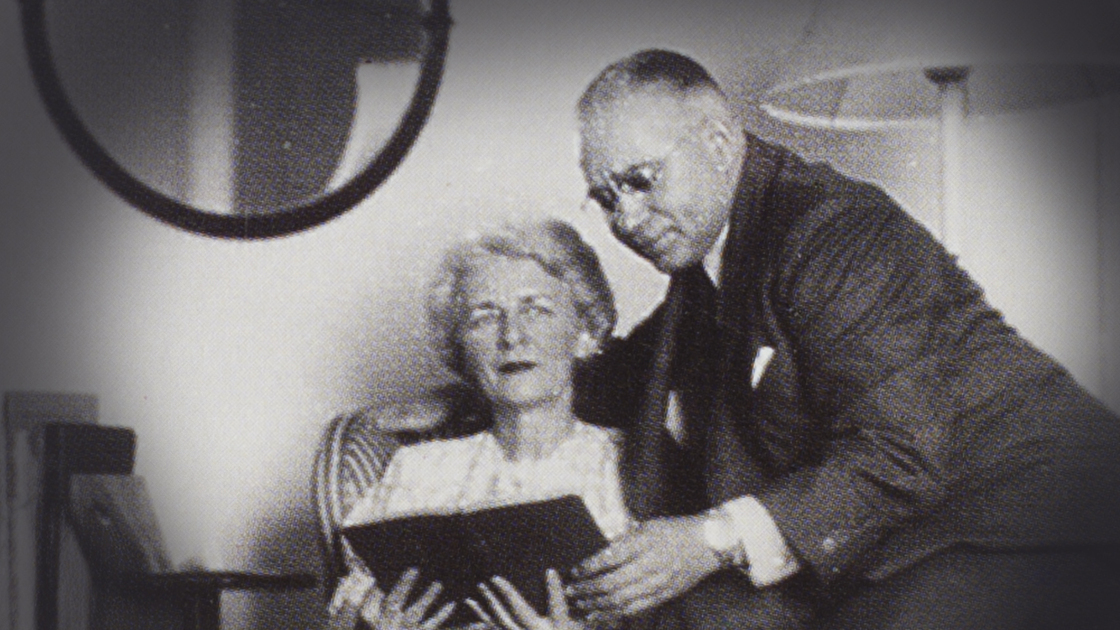
Herbert W. Armstrong taught that there are three basic ways by which people acquire their beliefs and convictions. The most common is that they carelessly believe, without proof, that which they have read or heard. The second most common way is to prejudicially accept any evidence that supports what they want to believe while rejecting any contrary evidence. The least common way is by sifting through all the facts, seeking full information, and considering the question objectively.
In Which Day Is the Christian Sabbath?, Mr. Armstrong noted, “I learned years ago that it can be very dangerous to carelessly assume, or just take for granted. It’s much wiser and safer to get all the facts, and then decide.”
When Mr. Armstrong’s wife, Loma, told him in 1926 that she had found in the Bible that Christians are bound to keep the seventh-day Sabbath from Friday sunset to Saturday sunset, Mr. Armstrong did not want to believe her. Yet after a six-month stint in the Portland library studying Bible commentaries, lexicons, encyclopedias and historical works like Gibbon’s Decline and Fall of the Roman Empire, he came to see that his wife was right.
Around the same time, Mr. Armstrong’s sister-in-law told him he was ignorant for not believing in evolution. He did not want to believe her either. So reading first the works of Charles Darwin, Ernst Haeckel, Herbert Spencer, Thomas Huxley, Karl Vogt and more recent and modern authorities, he delved into science. He learned how radioactivity proves there has been no past eternity of matter. He even visited the darkroom of an X-ray laboratory so he could see firsthand that when a tiny portion of radium was placed on a mirror at the far end of a hollow tube, the radium emitted tiny particles as it slowly decayed into lead. He left no stone unturned
until he had found conclusive proof that the universe was created and that his sister-in-law was wrong.
While he was studying, Mr. Armstrong contacted a minister in Florida who told him that unless he knew that the people of the United States and Great Britain were descended from the so-called lost 10 tribes of Israel, he was ignorant. So Mr. Armstrong obtained all the literature he could find on the subject, and compared every point he read with the Bible. He found significant errors in every book or pamphlet, yet he still had to acknowledge that the American and British peoples had in fact descended from ancient Israel. He soon started writing his own book on the topic that was free from the errors he found in the existing British-Israelite literature. More importantly, his book contained a vital new dimension of revelation: showing these end-time nations in prophecy.
Mr. Armstrong grew in grace and knowledge throughout his life because he refused to assume anything. As he explained in a June 1969 Plain Truth personal, he always arrived at his conclusions “by careful sifting of all the facts, actively seeking full information, insisting on proof, and considering the question objectively and without prejudice. But most of the beliefs held by most of the people have not been arrived at by this process.”