
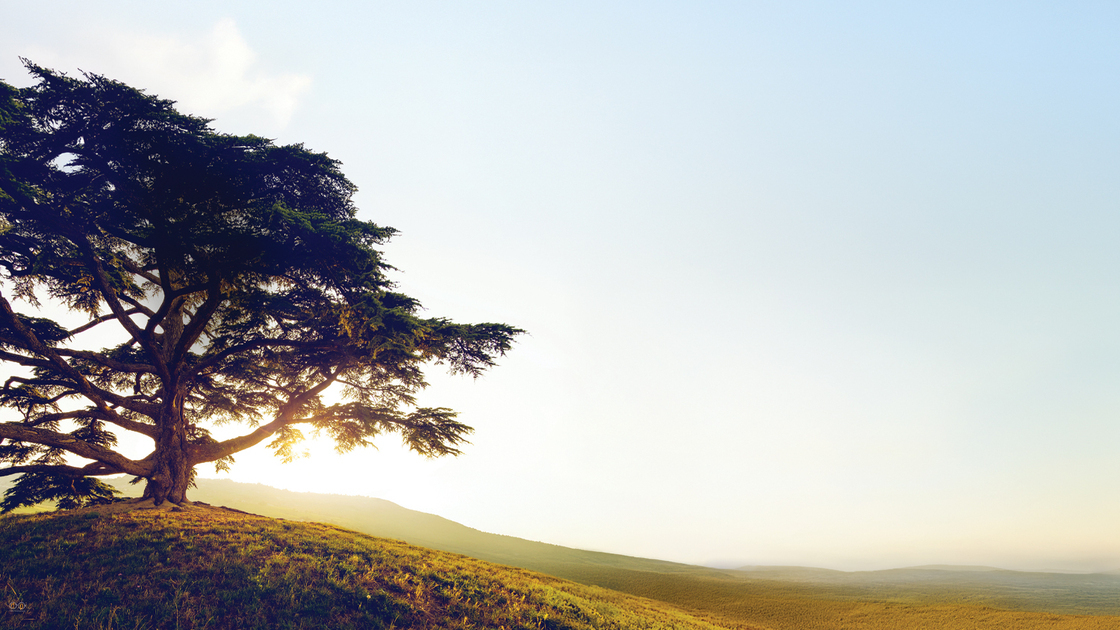
God speaks a lot about the cedars of Lebanon in the Bible. Around 70 verses discuss this tree. That is a lot of verses dedicated to a tree!
Psalm 104 describes God’s mighty creative power. Verse 16 says, “The trees of the Lord are full of sap; the cedars of Lebanon, which he hath planted.” God Himself has planted these trees!
Why did He plant the cedar of Lebanon? And why does He emphasize this throughout the Bible?
The cedar of Lebanon makes for an inspiring study. This tree offers tremendous lessons we can all apply to our lives.
Grow Like the Cedar
The majestic cedar of Lebanon has been called “the king of trees.” It is one of the strongest trees in the world. Where is there one greater and more magnificent?
“The righteous shall flourish like the palm tree: he shall grow like a cedar in Lebanon” (Psalm 92:12).
No other tree grows like this cedar. It can grow up to 120 feet tall—2½ times the height of the pillars in front of Armstrong Auditorium. Its branches spread wide, growing straight out 30 to 50 feet from the trunk.
This tree illustrates the spiritual growth God wants to see in all people! If we are righteous, we will grow like the cedar of Lebanon. How inspiring! We need to be growing in righteousness like this stately tree.
If we are to have spiritual greatness, we need to understand this lesson. God wants us to become spiritually strong and regal like that cedar.
Judges 9 tells of evil Abimelech, who connived to become king over Israel. He killed all his own brothers—but Jotham, the youngest, escaped. Jotham spoke a parable that was also a prophecy—and it used trees to symbolize the evil that Abimelech had committed.
In the parable, the trees were looking for a king to rule them. They asked the olive tree, which refused; then the fig tree, which also declined; then the vine, which also rejected the offer. “Then said all the trees unto the bramble, Come thou, and reign over us. And the bramble said unto the trees, If in truth ye anoint me king over you, then come and put your trust in my shadow: and if not, let fire come out of the bramble, and devour the cedars of Lebanon” (verses 14-15). In Jotham’s parable, the bramble was Abimelech—and those cedars represented the elders and chiefs of Israel. Again you see the cedars representing nobleness and dignity.
We are God’s kings and priests! (Revelation 1:6; 5:10). God has specially chosen us for that spectacular calling.
Fit for the Temple
Toward the end of his life, Moses beseeched God to allow him to enter the Promised Land: “O Lord God, thou hast begun to shew thy servant thy greatness, and thy mighty hand: for what God is there in heaven or in earth, that can do according to thy works, and according to thy might? I pray thee, let me go over, and see the good land that is beyond Jordan, that goodly mountain, and Lebanon” (Deuteronomy 3:24-25). Lebanon had a reputation for its beauty, and its cedars were a major reason for that.
Centuries later, King Solomon was building Israel to its peak of achievement. He sent word to the king of Tyre, a prominent Phoenician city-state on the coast of modern-day Lebanon. The king, Hiram, had been close with Solomon’s father, King David. Solomon said, “[B]ehold, I purpose to build an house unto the name of the Lord my God, as the Lord spake unto David my father …. Now therefore command thou that they hew me cedar trees out of Lebanon …” (1 Kings 5:5-6).
Solomon wanted to make God’s temple the best quality it could possibly be. And he wanted those cedar trees to be used for his great purpose, out of respect for his father and for the great God. “And the house which I build is great: for great is our God above all gods” (2 Chronicles 2:5). This house had to be great just like those cedar trees!
Solomon continued, “Send me also cedar trees, fir trees, and algum trees, out of Lebanon: for I know that thy servants can skill to cut timber in Lebanon; and, behold, my servants shall be with thy servants, Even to prepare me timber in abundance: for the house which I am about to build shall be wonderful great” (verses 8-9). This structure was to be exceedingly impressive—as great as they could possibly make it—as big, strong and beautiful as the cedars of Lebanon.
God’s people make up God’s spiritual temple today (e.g. Ephesians 2:19-22; 1 Peter 2:4-5). We want to become the choicest materials God can use—like those mighty cedars of Lebanon.
The Grandeur of Lebanon
Solomon wrote Song of Songs. This wonderful poem has deep meaning for us in this final era of God’s Church (request my free booklet The Song of Songs—God’s Greatest Love Song).
This poem makes several references to Lebanon: about its grandeur, its refreshing streams, its enticing scents, even its impressive architecture. The picture of Lebanon, a nation once known as the “Pearl of the Mediterranean,” is so positive and inspiring.
“Come with me from Lebanon, my spouse, with me from Lebanon: look from the top of Amana, from the top of Shenir and Hermon, from the lions’ dens, from the mountains of the leopards” (Song of Songs 4:8). The husband and wife are growing together, helping each other grow in this royal marriage.
“Thy lips, O my spouse, drop as the honeycomb: honey and milk are under thy tongue; and the smell of thy garments is like the smell of Lebanon. … A fountain of gardens, a well of living waters, and streams from Lebanon” (verses 11, 15). This is about living waters—the Holy Spirit of God that produces real life! Our human life is just a chemical existence; we live and then die very quickly. This is not real life. God is talking about life forever with Him! He wants to give that to all of us. And He will—if we are growing spiritually like the cedars of Lebanon.
In Song of Songs 5:15, the wife says this about her husband, who is a type of Jesus Christ: “[H]is countenance is as Lebanon, excellent as the cedars.” This is another reference to those impressive cedars of Lebanon that reflect the exquisite character of God.
When you look at Lebanon today, it is hard to even imagine how splendid it was at that time. Several prophecies also reference the destruction of Lebanon. The better we understand the heights it once represented, the more we can recognize what a tragedy its fall has been—and take warning from these prophecies.
Destroyed Like Lebanon
Lebanon, once the jewel of the Middle East, has been destroyed. Today, it is on the brink of total failure as a state. The country has endured decades of corruption and external pressures. Its unstable government is paralyzed by infighting, its population lives in poverty, and its land is still smoldering from war with Israel because of Hezbollah’s malign influence.
Prophecy uses this imagery to show the kind of devastation that is soon to spread across the nations.
Habakkuk 2 includes a prophecy of devastating punishment from God. “For the violence of Lebanon shall cover thee, and the spoil of beasts, which made them afraid, because of men’s blood, and for the violence of the land, of the city, and of all that dwell therein” (verse 17).
Soon this whole world is going to be covered in “the violence of Lebanon.” Man’s sins and rebellion will cause a crescendo of destruction across the nations. God has allowed Lebanon to be destroyed, and the whole world is going to look like Lebanon if people do not repent and turn to Him.
The Prophet Isaiah also wrote of this coming destruction: “Behold, their valiant ones shall cry without: the ambassadors of peace shall weep bitterly. The highways lie waste, the wayfaring man ceaseth: he hath broken the covenant, he hath despised the cities, he regardeth no man. The earth mourneth and languisheth: Lebanon is ashamed and hewn down: Sharon is like a wilderness; and Bashan and Carmel shake off their fruits” (Isaiah 33:7-9). The ambassadors of peace will weep because the world is exploding in violence and wars. The most fertile countries are afflicted, including Lebanon. The whole Earth mourns.
Jeremiah prophesied of the fall of Jerusalem, which was a type of the fall of the nations in the end time. “[I]f ye will not hear these words, I swear by myself, saith the Lord, that this house shall become a desolation. For thus saith the Lord unto the king’s house of Judah; Thou art Gilead unto me, and the head of Lebanon: yet surely I will make thee a wilderness, and cities which are not inhabited” (Jeremiah 22:5-6). This is clearly end-time prophecy describing nuclear destruction.
“And I will prepare destroyers against thee, every one with his weapons: and they shall cut down thy choice cedars, and cast them into the fire” (verse 7). The great cedars of Lebanon are going to be burned up in the conflagration caused by people’s sins.
“Go up to Lebanon, and cry; and lift up thy voice in Bashan, and cry from the passages: for all thy lovers are destroyed. I spake unto thee in thy prosperity; but thou saidst, I will not hear. This hath been thy manner from thy youth, that thou obeyedst not my voice. The wind shall eat up all thy pastors, and thy lovers shall go into captivity: surely then shalt thou be ashamed and confounded for all thy wickedness” (verses 20-22). What wickedness fills our nations—and what severe punishment they will suffer as a result!
“O inhabitant of Lebanon, that makest thy nest in the cedars, how gracious shalt thou be when pangs come upon thee, the pain as of a woman in travail!” (verse 23). Those who are looking for protection in physical things—even as impressive as those cedars of Lebanon—are going to find themselves caught in the middle of that terrifying Tribulation. Terrible pain is coming!
Several scriptures, such as this one, compare that suffering to birth pangs. The Tribulation coming upon this world is like the labor pains that culminate in the birth of a new world!
A Fruitful Field
Prophecy is clear that, beyond the bad news, there is wonderful news. “Is it not yet a very little while, and Lebanon shall be turned into a fruitful field, and the fruitful field shall be esteemed as a forest?” (Isaiah 29:17). This is about the restoration of Lebanon to its former glory. Once Jesus Christ returns in power and glory, He will build a new world from the ground up. Even war-torn areas like Lebanon will be magnificent and inspiring!
“And in that day shall the deaf hear the words of the book, and the eyes of the blind shall see out of obscurity, and out of darkness. The meek also shall increase their joy in the Lord, and the poor among men shall rejoice in the Holy One of Israel” (verses 18-19). God is going to fill this Earth with joy and rejoicing!
You don’t see joy and rejoicing today, but rather all kinds of horrifying problems. But God wants to give us joy. If only we would trust Him, great joy would come into our lives. We have to come to love Him as He loves us.
“The wilderness and the solitary place shall be glad for them; and the desert shall rejoice, and blossom as the rose. It shall blossom abundantly, and rejoice even with joy and singing: the glory of Lebanon shall be given unto it, the excellency of Carmel and Sharon, they shall see the glory of the Lord, and the excellency of our God” (Isaiah 35:1-2). The world will come to display the glory of Lebanon at the peak of its beauty.
“Strengthen ye the weak hands, and confirm the feeble knees. Say to them that are of a fearful heart, Be strong, fear not: behold, your God will come with vengeance, even God with a recompence; he will come and save you” (verses 3-4). God has given His people a hope-filled message that really can strengthen the weak. We need to help and serve those who are feeble!
Isaiah also prophesied about Jerusalem in the Millennium: “The glory of Lebanon shall come unto thee, the fir tree, the pine tree, and the box together, to beautify the place of my sanctuary; and I will make the place of my feet glorious” (Isaiah 60:13). The cedars of Lebanon are going to beautify the capital city of the world once again. God wants them by His sanctuary in His wonderful World Tomorrow!
We have so many lessons to learn from these beautiful trees that God has planted. Grow like the cedar of Lebanon. Flourish and be strong like those majestic trees that God Himself has planted. Allow God to shape you into the finest material possible for your place within His spiritual temple. You too will blossom abundantly and receive the spiritual glory of Lebanon!