
Have you ever wondered what it is like to be a pilot? To be in control of a massive steel bird, the most popular of which weigh upwards of 70,000 pounds? To have the responsibility of safely navigating the skies under all kinds of weather conditions and times of day? To repeatedly handle the rigors of take-off and landing? All while being charged with the lives of hundreds of passengers? The job of a pilot is not easy, but it is one of great interest to me.
This summer, on a flight to Israel for an archaeological excavation, I was given the opportunity to sit jump-seat in the cockpit. The jump seat is located right behind the pilots, so I had a perfect view of everything they were doing throughout the flight. I was even able to listen to their communications with air traffic control. It is one thing to watch movies or documentaries about pilots; it is an entirely different experience to be there in the cockpit and observe it all taking place in real time. This was an incredibly special opportunity, and I was going to make the most of it.
There were several things I quickly started to realize. There are so many blind spots from the cockpit. Your vision of what is in front of you is narrow. Your ability to see what is around you is very limited. This was not like my four-door sedan with glass windows all around and a review mirror. This is a massive aerodynamic piece of metal that only allows looking forward and to part of the periphery. The pilot thus is very dependent on air traffic control, the ground crew, and the clusters of instruments in front of him for safe navigation. He would crash if he attempted to chart his own course independent of these aids.
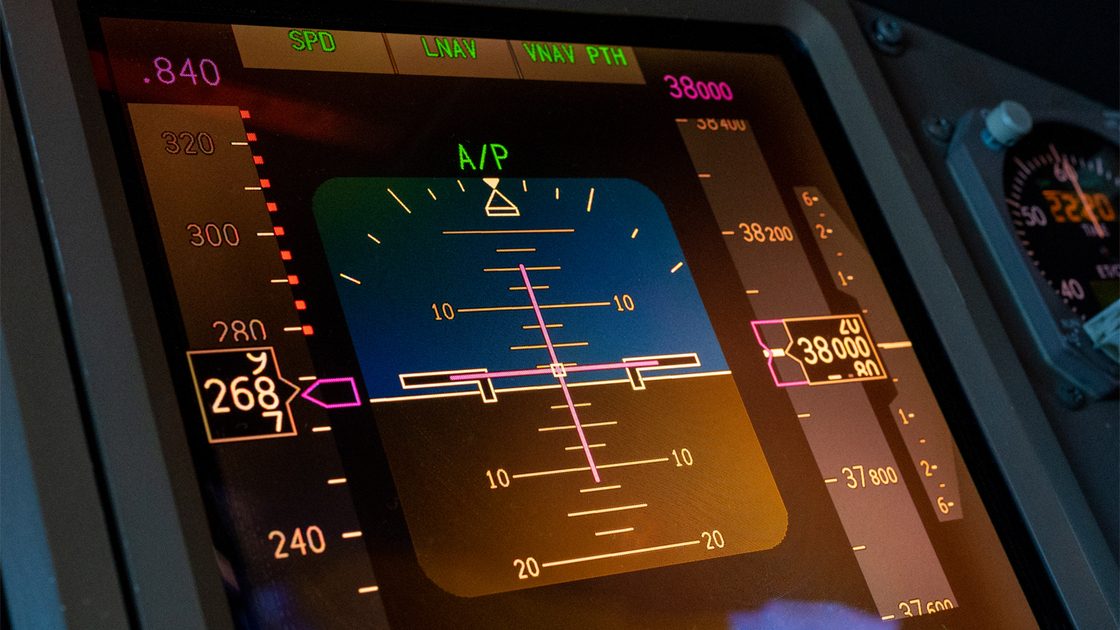
One of the things I really was excited to see was the use of autopilot. Sure enough, after take-off the pilot engaged it. In its simplest form, autopilot is a computer system that keeps the plane on course without the pilot having to constantly steer. Think of it sort of like cruise control in a car the driver sets the speed, and the car accelerates accordingly to stay on that target, keeping the driver from having to ride the throttle.
There were two main parameters I saw the pilots adjust while in autopilot: the heading and altitude. The heading is the direction the plane is flying, and the altitude is how high the plane is in the air. And of course, these parameters are not something that the pilot just dials in haphazardly. No, they are done with extreme precision, and at the request of air traffic control.
As soon as we took off, air traffic control was providing instructions to the pilots on the necessary heading and altitude as they left the airport. When we were clear of airport traffic, new instructions were given to set the plane on course for its destination. Several times throughout the flight, the pilots were instructed to change the aircraft’s heading or altitude to ensure safe arrival to our destination.
This pattern continued throughout every part of the flight: The pilots would receive instruction from air traffic control, and they would immediately respond. Never did they protest; never did they say, “I think I know a better way, I am going to fly at 30,000 feet instead of 38,000 feet.” There was complete harmony of command between air traffic control and the pilots, as there needs to be. Otherwise, you would have all these planes in the air doing their own things, and the result would quickly be chaos and death.
Observing all this made me think of an analogy mentioned in our booklet Single Minded for God. “God doesn’t always answer immediately or give you what you want. He sees a bigger picture in your life than you do and knows what’s best in the end. Be patient and content in your circumstances until all the pieces fall into place. A temporary ‘no’ from God may be compared to a plane sitting on a runway awaiting takeoff. God is the traffic controller in the tower who sees the dangers all around not visible to the pilot in the plane. Only when it is clear and safe for takeoff will God give approval. Don’t be discouraged with the ‘holding patterns’ you may encounter in life — be confident that God is imminently in charge!”
In the busy skies of today, a pilot cannot chart his own course. His limited vision of his surroundings and knowledge of potential dangers would set him on a collision course. So it is in our lives, Jeremiah realized this and was inspired to write, “O Lord, I know that the way of man is not in himself: it is not in man that walketh to direct his steps” (Jeremiah 10:23). Trying to chart our own course in life would be like a pilot trying to fly a commercial plane between two airports without any guidance. It would be doomed for disaster; he would be lucky even to make it safely off the runway.
Think about it. How many times do we try to make our own decisions in life without listening to the instructions coming from “air traffic control”? It can be easy at times to hang up the coms and ignore our parents, counsel from the ministry, or maybe even clear instruction written in God’s Word—thinking we have a better way. Somehow, we think we will land at our destination safely, yet often it ends in a crash.
When I was going through high school, for example, the last thing I wanted to do was go to Herbert W. Armstrong College. The thought of going back to school after finishing 12 years of it was not something that appealed to me. I had better things to do than take tests and write essays. I had my own business. I was going to be a successful entrepreneur. I was going to establish myself, save up a nice nest egg, and secure a home—you know, put myself in a position to have a family. Surely that was the right path to take; college would be nothing more than four-year distraction from where I should be.
The problem, I was trying to chart my own course. I was hanging up the coms set with air traffic control and getting ready to fire up the engines my way. Because of course, I knew better, and “college isn’t for everyone,” right?
Thankfully, in my final year of high school, I came to realize that it did not matter what I wanted. The only thing that really mattered was, Where does God want me to be? The only way I knew to let Him make that decision was to submit my application for Herbert W. Armstrong College. Whatever the response was in the returning letter, would be my answer. I was accepted, and I can tell you that it has led to the best years of my life. I have been given opportunities like I never would have dreamed, and it all stemmed from that one decision: to tune back into air traffic control and let God direct my course.
I share that story not only because a lot of young people come to that crossroad, but because it is typical of so many decisions in life. There is always an idea we have in mind of what we want to do, and often it does not always align with the course God is charting. So, which do you choose? If you are the pilot and air traffic control tells you to change your heading to 220, do you? Do you hesitate? Or do you dial in a different heading, maybe just slightly off?
“Trust in the Lord with all thine heart; and lean not unto thine own understanding. In all thy ways acknowledge him, and he shall direct thy paths” (Proverbs 3:5-6).
God is telling us to let Him direct our paths. He warns us specifically against leaning on our own decision-making. Like pilots in the cockpit, we can’t see much! God knows what is best, and, just like the air traffic controller, He sees all the potential dangers. He knows the perfect time for take-off and landing. He knows exactly when and where to change course, when to raise or lower altitude. We must learn to trust Him.
Not only does God know what is best for us, He wants what is best for us. “Beloved, I wish above all things that thou mayest prosper and be in health, even as thy soul prospereth” (3 John 2). The heading God wants to put you on will result in physical and spiritual prosperity.
“And we know that all things work together for good to them that love God, to them who are the called according to his purpose” (Romans 8:28). God always has our best interests at heart. He wants to fill our lives with blessings. Will we let Him?
After many experiences over the years, I have come to realize that I don’t always get what I want, but what God gives me is better than I could ever dream. Yes, we often have our own ideas of what would be good for us, but often it never ends the way we planned. However, when we submit to God and let Him direct our paths, if we are seeking His will, listening to the instruction that flows down through His government, then He will pour out blessings upon us far greater than we could have ever imagined.
If I did it my way and never applied to Armstrong College, I have no idea where I would be today. I can tell you that life would not be as happy. I would not be working my dream job, which came as a result of God’s “heading.” I would never have established the friendships that I enjoy today. And honestly, my heart would not be as involved in God’s Work, if at all. Armstrong College revolutionized my life!
That is what happens when we submit to God’s paths. The life I was going to build my way pales in significance to the life God is helping me build, and every day it keeps getting better. This has been my experience, and I know it will be yours as well if you let God set your heading.