
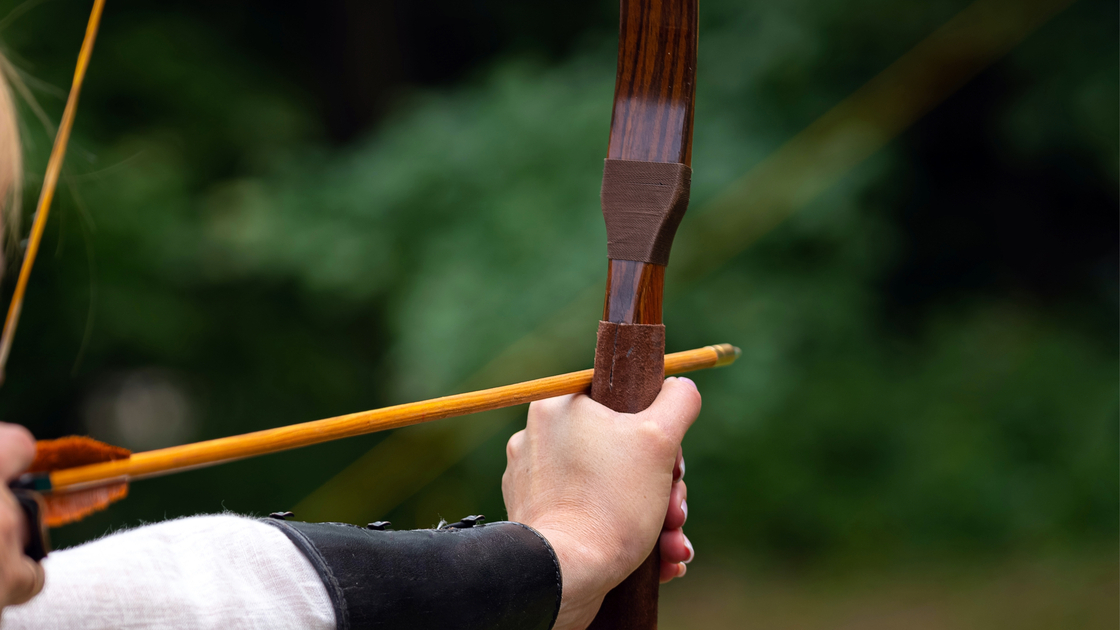
Consider a piece of string. Does it look like a weapon? Maybe it could choke someone, but it’s not much on its own. But what happens when you attach it to a bow?
When the bow was introduced into British warfare, it was a game changer. In medieval England spanning from the 13th to 16th centuries, the longbow was a cornerstone of military power. It could shoot arrows from 200 yards or more with enough force to penetrate armor!
Winston Churchill, in A History of the English-Speaking Peoples, wrote, “A new type of infantry raised from the common people began to prove its dominating quality.” He described one of their enemies: “One of his knights had been hit by an arrow which pierced not only the skirts of his mailed shirt, but his mailed breeches, his thigh, and the wood of his saddle, and finally struck deep into the horse’s flank.”
Being able to strike enemies that hard from that distance gave England a huge advantage. The English were practically unstoppable. They gained victories! “This was a new fact in the history of war, which is also a part of the history of civilization,” Churchill wrote, “deserving to be mentioned with the triumph of bronze over flint, or iron over bronze” (ibid).
A bow and arrow is a great example of mechanical synergy. The limbs are the upper and lower flexible parts of the bow. The riser is the rigid central part, which connects the limbs and provides grip for the archer. The bowstring is a strong, flexible cord attached to the tips of the limbs, and it transfers energy to the arrow.
When an archer pulls back the bowstring, the limbs of the bow bend, storing potential energy. This action takes effort. The limbs resist bending. This resistance is the bow’s draw weight. The string, under tension, holds the limbs bent, ready to release the stored energy. The limbs’ flexibility allows them to deform without breaking. The string’s strength ensures it can withstand the tension.
Each component gives 100 percent effort: The limbs fully flex; the string fully stretches. When the archer releases the string, the limbs snap back to their original shape. This rapidly transfers the stored potential energy into kinetic energy. This energy propels the string forward, which accelerates the arrow to leave the bow at a high speed—often more than 200 feet per second.
If you wanted to shoot an arrow, how far would you be able to with just the bowstring? For that matter, how far could you make it if you only had the bow, with no string? You need both. The limbs and string amplify each other’s contributions. The limbs alone can’t launch the arrow, and the string alone has no power without the limbs’ stored energy. Together, they launch the arrow with speed, distance and accuracy. They produce a result greater than the sum of their individual capabilities.
This is a picture of how God works in our lives. You, by yourself, are like the string: You can’t accomplish anything spiritually of yourself. God is like the bow: When you connect yourself and put forth effort, like drawing back—God gives power!
The arrows are the things you want to accomplish in life—building a strong, happy family; building strong relationships with God and with fellow man; getting a good, successful, challenging career; building worthwhile skills and hobbies that you can serve others with; having satisfying accomplishments in your life; building godly character—having spiritual success—preparing for eternal life in God’s Family! You’re going to hit the target—bull’s eye—in all those areas if you use your bow properly!
Nothing But a String
In John 15:5, Jesus Christ tells us a hard truth: “… without me ye can do nothing.” It is easy to think we can do quite a lot on our own and to rely on ourselves for things we need God for! In Gerald Flurry’s sermon at the 2024 Summer Educational Program, he outlined four points on giving God victories, and his third point was: in you dwells no good thing.
It took me a long time to learn that in me dwells no good thing. My last year of college, I finally recognized it as I never had before. As I get older, it’s something I continue to learn more deeply! This is hard even for adults to understand, but God’s apostle said that to teens. And to really win victories, it is so important!
Herbert W. Armstrong had a lot of self-confidence. God really had to humble him. “I was never converted until I was brought to the place where I realized my own nothingness, and God’s all-encompassing greatness—until I felt completely whipped, defeated,” he wrote in his autobiography. “When I came to consider myself as a worthless burned-out ‘hunk of human junk’ not even worth throwing on the junk pile of human derelicts, truly remorseful for having imagined I was a ‘somebody’—completely and totally and bitterly sorry for the direction I had traveled and the things I had done—really and truly repentant ….”
By the time I was baptized, that’s exactly the way I felt. My hope is that you won’t have as big a mountain to climb as I did—that God can give you better perspective even now, through your parents and teachers, to help you remain humble and little in your own sight.
Connect to the Bow
Let’s see the flip side. Philippians 4:13 says, “I can do all things through Christ which strengtheneth me.” If you’re just a worthless string, once you’re attached to the bow, you’re very powerful! God says you can do all things.
You have to realize how much you need God. Have a clear picture in your mind of the difference between just a string and a bowstring attached to the bow. What does that tell you? Every day you have to attach yourself to that bow.
The string is attached to the bow at two points, at the end of either limb. You could liken this to prayer and study. You need both—every day! If you don’t have those, you can accomplish nothing.
Mr. Armstrong wrote in The Incredible Human Potential: “When you study the Bible, God is talking to you. When you pray, you are talking to Him. You get to really know God in this manner, just as you become better acquainted with people by conversation.” You get to know God primarily through Bible study and prayer.
Prayer is hard. Talking to a Being you can’t see doesn’t come naturally. But it is absolutely worth the effort of learning how to do it effectively. Prayer gives you a direct line of communication to the Creator of the universe! You can make requests, and He will use His unlimited power to answer. Look at 1 John 5:14-15: “And this is the confidence that we have in him, that, if we ask any thing according to his will, he heareth us: And if we know that he hear us, whatsoever we ask, we know that we have the petitions that we desired of him.” What a promise! But how can you receive that promise? The Bible shows that there are conditions. We have to do our part, then God will do His. You need to know those conditions and learn how to keep them.
In his article “Make Your Bible Study More Profitable,” Stephen Flurry wrote: “Go into Bible study prepared to analyze yourself. … You study to show yourself where you can improve …. Bible study is not just about gaining academic knowledge or proving a certain doctrine (though that is certainly a part of it). The ultimate goal of Bible study is to get us closer to the measure of the stature of Jesus Christ …. We study the Bible to become perfect. But we’ll never glean much profit from it unless we go into each study session looking to correct ourselves” (emphasis added). 2 Timothy 3:16 calls all Bible study “profitable” to us! This is the major way God talks to us. We really need to listen!
God’s Part, Our Part
Read Deuteronomy 5:31-33. God wants us to have a good life. He wants us be happy and enjoy ourselves! God gives the instruction in the Bible to help us, so it goes well with us. He tells us to stay away from things that hurt us. He commands things that are going to make our lives better, more rewarding. If you see someone who isn’t happy, then he is not applying God’s instruction. He is not walking in the way that God commanded. He is breaking God’s law.
Mr. Armstrong taught us from the Bible that there are two prerequisites to healing: faith and obedience. Think about those two things: Faith is trusting that God will do His part; obedience is doing our part.
James 2 says, “Yea, a man may say, Thou hast faith, and I have works: shew me thy faith without thy works, and I will shew thee my faith by my works. … But wilt thou know, O vain man, that faith without works is dead? … For as the body without the spirit is dead, so faith without works is dead also” (verses 18, 20, 26). We could say that the bow equals faith, and the string equals works. God’s part, your part—faith and obedience—you must have both!
Health is a perfect example. We need divine protection, healings and miracles. But God won’t provide those unless we’re taking care of ourselves—unless we’re obeying His health laws.
Mr. Armstrong wrote in his autobiography: “We have to learn that God does most things with us, and through us as His instruments. He only does for us what we are utterly unable to do ourselves.”
In reference to getting Ambassador College off the ground, Mr. Armstrong wrote: “We have had to fight the way through! We have had to think, to apply ourselves energetically, to drive ourselves on to the limit of our capacity. In this sense, God has let us do it—He merely directed us! But He also empowered us where necessary, and He brought about circumstances.”
It truly is a team effort! It’s a partnership. God onlydoes what we are unable to do for ourselves—He expects us to fight, think, apply ourselves, drive ourselves. Think of the effort involved in pulling that bowstring back. As we do that, He works miracles to do what we cannot. That’s a potent combination!
‘Pulling’ in the Effort
You have to draw the string back all the way to get full power. If you don’t, your arrow won’t go far, and it won’t go straight. The harder you draw, the more potential energy you gain from the bow. The Bible tells us to put our full effort into everything we do (Ecclesiastes 9:10; Colossians 3:23). The time when God can really work miracles in your life is when you’re really in a challenge, when you’re doing what pushes you, when you’re at the edge of what you’re capable of doing yourself.
The English longbow was typically around six feet long. It required immense physical strength to draw. Draw weights—the amount of force required to pull the bowstring back to its full draw length—were often 100 to 150 pounds. An archer needed to exert 100 to 150 pounds of force with his arms, shoulders and back. Pulling such a heavy bow required years of training, developing extraordinary skill and strength from a young age. In fact, English boys were encouraged or even commanded to train with the longbow from childhood, often starting as young as 7 or 8. Kings passed edicts emphasizing archery practice so they would have a ready supply of skilled archers for war.
There are things we learn over time, throughout our lives. We grow deeper in seeing God, fearing God, knowing God, loving God. You are not too young to start learning these things now!
In a May-June 2016 Royal Vision article, “Your Incredible Potential—and Your Children’s,” Gerald Flurry wrote about his grandson’s experience dancing at the Irish dance Worlds competition. He really had to push hard and rely on God to get there! “These types of experiences teach our children so much. They learn about how, if they step out on faith, God will reward that faith. Whatever they do, if they do it with God, they get to know God a lot better. We are developing their talents, and they are growing spiritually in the process. That is the big rewardof these activities. Our main goal is not for our children to win awards—our main goal is to bring God into their lives. That is the greatest miracle on Earth for these young people! Look what God will do for our children who have the Holy Spirit working with them! They play a critical role in God’s purpose and plan!”
He continued: “It is critical that we do all we can to provide instruction and experiences that show our children God is real. They need to learn, even as young people, that you can depend on God! Any young person can prove that. God will see to it that they know He is backing and supporting them. He loves doing that, and does it all the time for our young people, but He wants to do it even more.”
This is a deep spiritual concept, but it is very practical—and something you can understand.
In Medieval England, young men trained relentlessly, practicing at village archery ranges. Constant practice built technical skill and strong upper bodies. Some skeletal remains show enlarged left arms and shoulder bones deformed from years of drawing heavy bows. The longbow became an extension of their bodies. It allowed them to shoot with remarkable speed and power, loosing 10 to 12 arrows per minute in battle—drawing 100 to 150 pounds every few seconds!
The Bow of a Mighty Warrior
Psalm 18 contains a powerful message from a mighty spiritual warrior. David was facing serious threats, but he was on the offensive—because he knew how to let God lead him in battle.
The header for Psalm 18 says, “To the chief Musician, A Psalm of David, the servant of the Lord, who spake unto the Lord the words of this song in the day that the Lord delivered him from the hand of all his enemies, and from the hand of Saul ….” Experiencing those kinds of events inspired David to write a song! Do we really praise and thank God enough when He delivers us? When He performs miracles in our lives? Take some lessons from David and the way he praised God!
“I will love thee, O Lord, my strength” (verse 1). When you experience something like that, that should increase your love for God. Mr. Flurry writes about this psalm in The Psalms of David and the Psalter of Tara: “After that deliverance from trial, David truly wanted God to know how much he loved Him! When God gave us victory after our six-year court battle with the Worldwide Church of God, we really thanked God for it. But after studying David’s words here, I think we could have done better. David deeply loved God for what He did!” No surprise God loved this man so much!
This tone carries through the entirety of this psalm. “The Lord is my rock, and my fortress, and my deliverer; my God, my strength, in whom I will trust; my buckler, and the horn of my salvation, and my high tower” (verse 2). You might think this was just naturally the way he thought. No! David had to push himself to think this way! When he wrote this, he was actually struggling emotionally. Verses 4-5 read, “The sorrows of death compassed me, and the floods of ungodly men made me afraid. The sorrows of hell compassed me about: the snares of death prevented me.” It’s like he was surrounded by snares—trapped!
The Psalms of David and the Psalter of Taracontinues: “He was human; he had sorrows and fears. But what did he do with those emotions?” Verse 6: “In my distress I called upon the Lord, and cried unto my God: he heard my voice out of his temple, and my cry came before him, even into his ears.” When you are struggling or are in a tough situation, talk to God about it! There is never a time when you cannot go to God about whatever you are experiencing. You can be in the heat of the battle and calling on God for strength. He makes Himself available to you! Without Him, you are just a string. If you are going to achieve victories on the field of battle, you must be drawing on His power.
Verse 32 reads, “It is God that girdeth me with strength, and maketh my way perfect.” Mr. Flurry writes, “So much of this psalm describes what God did to deliver David. That doesn’t mean David did nothing. Several verses describe how God empowered David’s actions in handling his enemies.”
That is the partnership we are discussing: God empowering you. God gives you what you need to succeed. “It is God that does these things—God in us! We can of our own selves do nothing. David was empowered by the Holy Spirit in fighting his battles. He was deeply aware of that and so thankful” (ibid). You have that power working with you in your life!
“He teacheth my hands to war, so that a bowof steel is broken by mine arms” (verse 34). “David was a real warrior, and God was his Trainer and Commander. We too must become mighty spiritual warriors; we need God to teach us to war!” (ibid; emphasis added).
The New International Version renders verse 34, “my arms can bend a bow of bronze.” Imagine the draw weight of a bronze bow! Yet David said with God’s power he could.
Study the rest of this psalm alongside what Mr. Flurry writes about it in The Psalms of David and the Psalter of Tara. David was a bold and mighty warrior because he made God his partner. Coming to the point where you’re able to really draw on God to give you that kind of power is a process that takes time.
England produced archers who were devastating on the battlefield. The archers’ ability to fire in coordinated volleys, often at ranges up to 300 yards, made them a fearsome force. Their lifelong training meant the bow felt like a natural extension of their arm.
God is working together with us—in partnership. He has His part, and we have our part—you have your part—like the bow and string.