
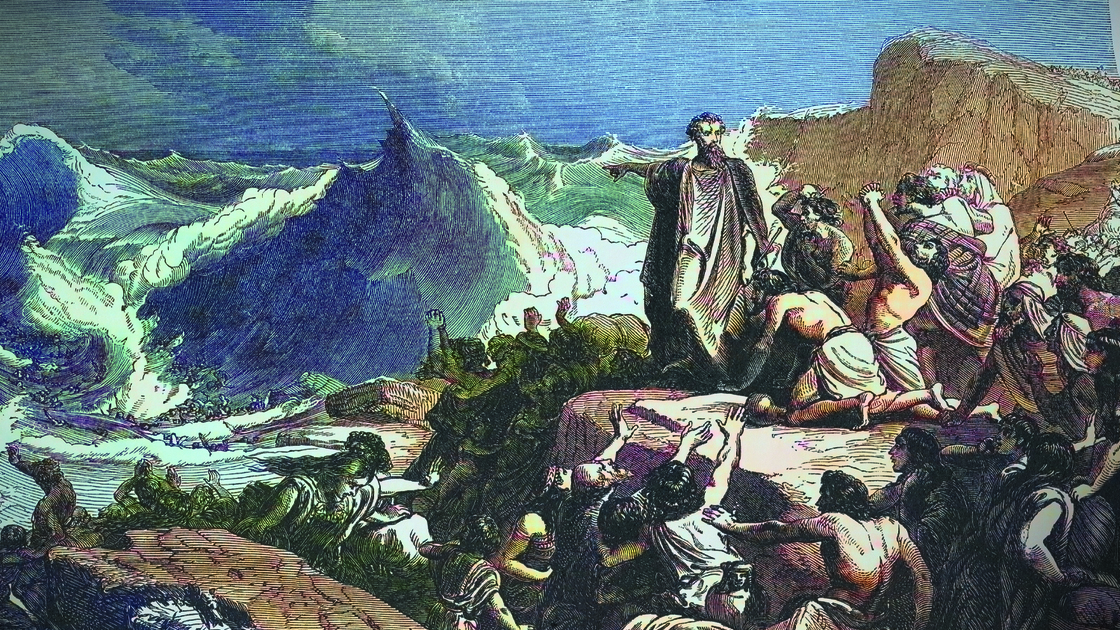
Probably the most misunderstood fruit of God’s Holy Spirit is meekness. It is often scorned as cowardice, timidity, fear or weakness. But what is meekness really?
One powerful man in the Bible is absolute proof that meekness is not weakness. Moses exercised absolute authority from God to rule millions of Israelites, but notice how the Bible describes him: “Now the man Moses was very meek, above all the men which were upon the face of the earth” (Numbers 12:3).
Plenty of events in the life of Moses show that he was capable of explosive rage. At the end of his 40 years as a prince of Egypt, he spotted an Egyptian taskmaster viciously beating a Hebrew slave and killed the abuser. When the Israelites engaged in hedonistic idolatry at Mt. Sinai, Moses furiously smashed the stone tablets containing the Ten Commandments. Later, when the people complained about a lack of drinking water, Moses angrily struck a rock to bring forth water.
The above actions show that Moses didn’t always perfectly control his emotions. He made some rather large errors in judgment when his emotions took over. Clearly, he was not a weak man.
Over time, Moses acquired the godly superpower of meekness and mastered it like literally no one else. He became meek but definitely not weak.
So what is meekness? How was the mighty Moses actually meek?
Meaning of Meekness
How meek are you? This thought-provoking self-examination question was posed in the headline of an article by the late pcg minister Charles Wire in the May-June 2010 Royal Vision. Much of the material in this section of my article, including other sources cited, comes from that wonderful article, which changed my perception of meekness. I highly recommend it.
In Scriptures’ use of meek or meekness “the exercises of it are first and chiefly toward God,” states Vine’s Expository Dictionary of New Testament Words. “It is that temper of spirit in which we accept His dealings with us as good, and therefore without disputing or resisting.”
Meekness is the attitude that we are nothing apart from God—that He knows best. “And we know that all things work together for good to them that love God, to them who are the called according to his purpose” (Romans 8:28).
There is gentleness in meekness. This comes from submission to God’s will. “Behind the gentleness there is the strength of steel, for the supreme characteristic of the man who is [meek] is that he is the man who is under perfect control,” writes William Barclay in New Testament Words. “It is a strength under control. … He is perfectly God-controlled, for only God can give him that perfect mastery. … [Meekness] is strength under control, but it would be wrong to say that the man who is [meek] is perfectly self-controlled. He is perfectly God-controlled ….”
Since meekness is one of the nine fruits of the Spirit that the Apostle Paul lists in Galatians 5:22-23, this character trait comes from God. “We cannot generate meekness on our own or accidentally acquire it. We must ask God for more of His Spirit and the fruit it produces (Royal Vision).
Mr. Wire connects this trait to other fruits of the Spirit. “Notice that meekness is listed here between faith and temperance. We must have faith that God’s dealings with us are for our good, for our benefit (Romans 8:28). Then, in meekness, we accept His direction without disputing or resisting. The result of meekness then is temperance or self-control: the right use of the power that God gives us. We are strengthened and guided by the Holy Spirit, so it really is God controlling us.”
Meek Like Moses
Moses learned meekness through harrowing experience. After years and years of trials and tests, he understood the inescapable fact that God knows best. Through all the highs and lows of life, Moses saw that God was always with Him. He learned to accept God’s dealings with him as good, without disputing or resisting.
Then, God gave Moses lots of power, knowing that Moses would remain God-controlled in using that power. In other words, Moses became meek.
Remember Numbers 12:3, which called him “very meek, above all the men which were upon the face of the earth.” The context surrounding this verse is fascinating.
Aaron and Miriam spoke against Moses (verses 1-2)—a serious offense because Moses was God’s man! How easy it can be to speak a little too freely when someone in authority over us makes a mistake—or even just makes a decision with which we disagree. Numbers 12 is a stern reminder that we ought to tremble to speak against those God has placed in authority—such as parents, teachers, and ministers.
Moses had the power to execute Aaron and Miriam. Instead, he accepted God’s punishment: Miriam became leprous. Moses even prayed that Miriam would be quickly healed. Moses dealt with their disrespect with grace and meekness. He did not let his vast power from God go to his head and make him arrogant.
In leadership, different situations require different approaches. But in this case, the meekness of Moses defused the tension and allowed God to carry out the solution. In almost every situation, Moses was mindful of God’s will and used his authority appropriately as a result.
What a lesson for all of us when given any position of authority. You might be designated as a group leader for a class project, a team captain in Physical Education class, or an Irish dance instructor for gangly 5-year-old goofballs like my son. As you grow older and grow in meekness, God will entrust you with even more weighty positions of authority. He is watching to see how you respond.
But even in times when you have no authority over others at all, you still possess lots and lots of power. James 3 describes your tongue—your words and the way you choose to speak—as more powerful than a bucking bronco, a majestic ship or a raging fire!
“He that is faithful in that which is least is faithful also in much: and he that is unjust in the least is unjust also in much” (Luke 16:10). God gives us the power to choose the direction of our lives in all the so-called “least” areas. In every detail of every aspect of our lives, He expects us to meekly submit to His will. He knows best. His dealings with us are good, so we shouldn’t dispute or resist.
“Blessed are the meek: for they shall inherit the earth” (Matthew 5:5).
If you are meek like Moses today, you will rule the Earth with him in the World Tomorrow. Meekness is not weakness; it is your godly superpower!