
Making the invisible visible. That’s how I like to think of the Apostle Paul’s great analogies. He took deep spiritual concepts and made them memorable and clear so that even a child could visualize something otherwise too abstract to understand.
A perfect example of this is his frequent references to our spiritual warfare. Christians of his day weren’t much different physically than those alongside you at Sabbath services: Other than some able-bodied singles and a few muscular young married men, most of the congregations would not fit the description of a soldier—the frail widows, the napping children, the nursing mothers, the graying grandfathers.
But these are God’s soldiers, Paul said, in an invisible war. The widows in Rome were not Roman soldiers; the children attending services in Corinth did not need combat training. The nursing mothers in Thessalonica did not literally fight for Caesar. But this invisible warfare is real, so he made tangible comparisons when describing it.
In four of his epistles, he mentions our spiritual armor. To the Roman brethren, he called it the armor of light (Romans 13:12). To the Corinthians, he spoke of the armor of righteousness (2 Corinthians 6:7). To the Thessalonians, he mentioned what the breastplate and helmet represent spiritually (1 Thessalonians 5:8).
But Ephesians, written while he was a prisoner in Rome, contains the most picturesque and specific comparison. We know from Acts 28 that this particular incarceration was a “house arrest”—confinement to a house in Rome for two years. And it was customary in these situations for the prisoner to be chained to a Roman soldier.
Imagine being in that state for two years. You would definitely see a lot of that soldier, not to mention the many conversations you two might have. That provides some gripping context to what Paul writes in Ephesians 6. It’s from this house arrest that he goes piece by piece through a Roman soldier’s armor and ascribes a specific spiritual characteristic to each major element of the “whole armour of God.” You can read about these in verses 14-17.
Maybe when you read that, a Medieval knight comes to mind—a man entirely encased in metal. But that image didn’t exist yet. It’s clear from his terminology that he is referring to the typical first-century-a.d. Roman soldier.
Shielded
Verse 16 states: “Above all, taking the shield of faith, wherewith ye shall be able to quench all the fiery darts of the wicked.”
The “whole armor” is important, but by prefacing it with “above all,” it stresses that “shield of faith.”
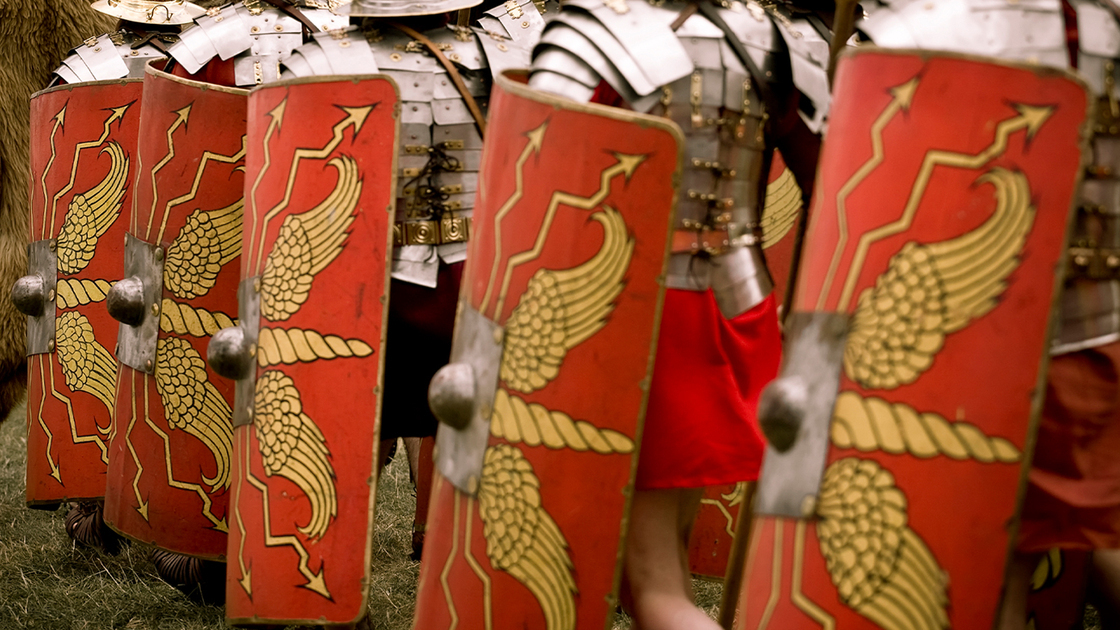
Imagine the imprisoned, house-bound apostle staring at an object like this—thinking about our invisible, spiritual struggles and meditating on what this specifically represents in this war. A shield is critical to battle.
Everything about the armor of God, with the exception of the sword, appears to be defensive. But the Roman shield, called a “scutum,” was more than just defensive; it was an offensive weapon too.
Shields are commonly mentioned in the Bible, especially in relation to the throne of David. There are shields of brass and shields of gold, though the latter would be more like trophies, rather than functional armaments (you wouldn’t want to have to lug around a shield of gold in battle).
The Song of Songs mentions the armory of David having 1,000 shields of mighty men (Song of Solomon 4:4). Solomon housed some in the “house of the forest of Lebanon” (1 Kings 10:17; 2 Chronicles 9:16). Some of David’s own shields were in the temple many years after his rule (2 Kings 11:10). Imagine walking through these buildings which doubled as museums of such mighty history!
In addition to literal shields, the Bible uses shields as symbolism for God’s protection. Many of those verses also bring up the concept of faith and trust. But Ephesians 6 gets us to think about the shield as something we are holding, not just something God does for us. And it gets us to consider what we’re being shielded from.
Best Defense
Consider what Ephesians 6:16 says the shield is defending us from: “… to quench all the fiery darts of the wicked.” The image here involves arrows from the enemy—fiery ones, at that. This is about defending against deception.
Our enemy, Satan the devil, is a great deceiver (Revelation 12:9). The bow and arrow allows its user to inflict damage from afar—removed from the dangers of up-close fighting—even from hiding.
Two of David’s psalms illustrate this: “For, lo, the wicked bend their bow, they make ready their arrow upon the string, that they may privily shoot at the upright in heart” (Psalm 11:2). “That they may shoot in secret at the perfect: suddenly do they shoot at him, and fear not” (Psalm 64:4).
This tactic of warfare is of great concern to any soldier, and it’s a perfect analogy for how Satan can work. Satan shoots at us “privily” or from the dark. Even with flame-tipped arrows (as in Paul’s analogy), you still might not know exactly from where it was fired.
The devil doesn’t necessarily want to confront you in person and fight you. He’d rather you hear a subtle comment from someone else or think a thought that you believe to be your idea.
When the enemy is working against us out of view, we must be highly alert. What we’re on guard against is deception.
The Apostle John wrote a vision he saw of a horseman wielding a bow (Revelation 6:1-2)—commonly termed the “first horseman of the apocalypse.” This horse represents the deadly epidemic of religious deception, and the bow is a fitting image of this deadly stealth.
There are plenty of ways that, even as a youth, you can educate yourself about God that will shield you from many of these deceptive tactics.
Satan wants to deceive and trick you. He wants you to believe you’re not even in a war. Or he doesn’t want you to think he’s the one you’re fighting. You may think it’s other things, or other people. That way he can get you to underestimate the deception. And he can shoot from the bushes, so you don’t even know what hit you.
The Prophet Jeremiah also uses the bow and arrow to describe deception (see Jeremiah 9:3, 5, 8). A lying tongue is likened to a bow and arrow, like an archer lying in wait—which is particularly dangerous in our spiritual warfare. We need to be shielded from deceit.
There are plenty of deceits that Satan tries to hurl at God’s young people. Deceits about the very existence of God and Satan—or, if God does exist, that He is the enemy. Or convincing us to draw back in making a connection with God. He tries to trick us into thinking certain dangers are actually harmless, and to be afraid of things that are actually good for us.
A common deceit is focusing more on visible, physical things than the spiritual. “For the love of money is the root of all evil: which while some coveted after, they have erred from the faith, and pierced themselves through with many sorrows” (1 Timothy 6:10). The illustration is one of being pierced by an arrow. If we err from the faith—if something damages our faith—it’s like we’ve dropped our shield!
Of Faith
So the Roman “scutum” Paul evoked represents the spiritual trait of faith. In 1 Timothy 6:12, he calls our spiritual war “the good fight of faith.”
Faith is a spiritual attribute—a fruit of God’s Holy Spirit (Galatians 5:22). Even if you are too young to have that Spirit dwelling in you, it does work with you, as sanctified youth attending God’s Church (1 Corinthians 7:14). Even the disciples, before they had God’s indwelling Holy Spirit, had a measure of faith. There are passages in the Old Testament too, admonishing Israelites (who did not have access to the Holy Spirit as an indwelling power) to trust in God as their shield (e.g., Psalm 115:9).
Even as a youth in God’s Church, there are things you believe in—that you can prove and be totally convinced about, that can protect and defend you from certain deceits!
Remember what faith is. Hebrews 11:1 gives a definition. Herbert W. Armstrong includes a definition in modern English based on that verse and elaborates on it in The Plain Truth About Healing: “Faith is the assurance that the things which God said in His Word are true and that God will act according to what He has said in His Word. This assurance, this reliance on God’s Word, this confidence, is faith!”
He ties faith to God’s Word. Romans 10:17 shows that it is the Bible that educates our faith. God’s Word, and faith in that, is a shield against someone convincing us otherwise, whether it’s getting us to wonder if God has even promised something or that what God did promise is just too outlandish or unrealistic to believe.
If we prove God’s Word, that quenches those fiery darts of deception! That shields us from subtle doubts that undermine God’s promises.
Shields are mentioned repeatedly in the Psalms—and in relation to having faith and trust in God. Surely Paul studied these a lot when writing about the armor of God in his epistles.
Psalm 18:2 is a great example: “The Lord is my rock, and my fortress, and my deliverer; my God, my strength, in whom I will trust; my buckler [the Hebrew means shield] ….” David is making a connection between the shield and his trust in God. Two other psalms do this explicitly: Psalm 28:7; 144:2.
Here in Psalm 18, David adds: “… the word of the Lord is tried: he is a buckler [shield] to all those that trust in him” (verse 30). God’s word is “tried,” which relates to the kind of refining a goldsmith does. It has been smelted, purified and tested. You must prove it for yourself! And God Himself is a shield to those who trust Him.
Verse 35 speaks of the “shield of thy salvation”—meaning it saves, rescues and delivers us. This is what we must put our trust in.
Shield Qualities
A Greek historian of the 2nd-century b.c. named Polybius described the Roman armor, saying it consisted “firstly” of a shield—this being one of the more impressive components of the Roman armor: “the convex surface of which measures two and a half feet in width and four feet in length, the thickness at the rim being a palm’s breadth. It is made of two planks glued together, the outer surface being then covered first with canvas and then with calf-skin. Its upper and lower rims are strengthened by an iron edging which protects it from descending blows and from injury when rested on the ground. It also has an iron shield boss (umbo) fixed to it which turns aside the most formidable blows of stones, pikes, and heavy missiles in general.”
Some Roman shields were more oval or circular, but the one Paul referenced is indicated by a Greek word similar to the Greek word for door—so it gives the sense of a four-cornered rectangle. This was the more common type in Paul’s day. It had been refined through many years of trial and error (more like trial and casualties) determining how thick it needed to be, and reinforcing the iron edges for strength without making it too heavy.
It was light enough to be held in one hand. Its large height and width covered nearly the entire soldier! Polybius said that the soldiers’ “protection and confidence … owed to the size of the shield.”
Psalm 91 evokes the confidence that comes from God as our shield: “He shall cover thee with his feathers, and under his wings shalt thou trust: his truth shall be thy shield and buckler” (verse 4).
The word translated “buckler” is a unique word that, again, probably means shield. But the word translated “shield” in the King James Version literally means “thorn,” and it could be translated “target” (as it is in five other verses). This may refer to the center of the shield—which the Romans called the “boss,” that they used for punching. Because of the literal Hebrew meaning, it may refer to shields that had some sort of sharpened boss, where it could actually puncture things.
Earlier we described a shield’s protection against faraway shots, but this hints at its usefulness in up-close combat.
This Psalm likens both the shield and buckler to God’s truth—something we can completely trust.
Now comes some next-level faith! “Thou shalt not be afraid for the terror by night; nor for the arrow that flieth by day” (verse 5). This relaxed faith has no fear.
We don’t need to fear physical arrows flying around us by day, nor those even deadlier fiery darts of deception from Satan.
Humanly we may not “feel” safe, but we won’t be made safe by our feelings. Mr. Armstrong wrote in What Is Faith?: “Your feeling, your convictions, your impressions, have absolutely not one thing or the other to do with faith. Faith has only to do with God’s Word! The one question is, Has God promised it in the Bible? If He has, then probabilities, possibilities, feelings, convictions, impressions, have nothing whatsoever to do with it. God has a thousand ways we know nothing of, of answering and providing whatever He has promised. We don’t need to see how He is going to do it.”
As Polybius said, the soldiers’ “protection and confidence … owed to the size of the shield.” The size of the Roman scutum factored into its effectiveness. It was so large that it could hide the other hand (the free hand, which held the sword). The opponent wouldn’t know if the sword was coming over, under or around the shield.
Consider the size of your faith. Jesus talked about “great faith” and those of “little faith.” Have you thought of the size of your faith as being equivalent to the size of a soldier’s shield? You definitely wouldn’t want a tiny shield out on the battlefield, right?
The Shell of Faith
One inspiring aspect of the scutum relates to how Roman regiments used them collectively as a team. The shield’s slightly rounded surface allowed it to be placed next to another and for soldiers in a group to interlock them, creating a large barrier. This was known as the testudo formation (the Latin word for tortoise). This massive shell defended the entire contingent against descending projectiles.
Cassius Dio, a Roman historian from the third century a.d., recorded this about the testudo: “One day, when they fell into an ambush and were being struck by dense showers of arrows, [the legionaries] suddenly formed the testudo by joining their shields, and rested their left knees on the ground. The barbarians … threw aside their bows, leaped from their horses, and drawing their daggers, came up close to put an end to them. At this the Romans sprang to their feet, extended their battle-line … and confronting the foe face to face, fell upon them … and cut down great numbers.”
So the Roman shield allowed for a collective (not just individual) defense. Soldiers would kneel, and then combine shields to create this shell-like barrier.
Not only is kneeling (in prayer) critical to our success individually, this is also true of our collective faith. There is power when we put our faith alongside the faith of a fellow believer. It creates a formidable barrier against enemy projectiles!
In Romans 1:12, the Apostle Paul said: “… that I may be comforted together with you by the mutual faith both of you and me.” His faith helped the members, and their faith helped him.
If your faith is being tested in a certain area, talking with a friend who has already been through that test can strengthen yours. Some issues, of course, require counsel with a parent or minister, but simply sharing matters of faith can really increase your defenses. At the very least, we should be sharing miracles in our lives with others in God’s Family. That increases our faith and enlarges our shield!
The testudo formation also required a certain closeness of the soldiers. Imagine what any gap in those shields would allow. What if it weren’t completely unified? That would have weakened the shell. The Apostle Paul actually referenced the “unity of the faith” in the same epistle where he outlined the armor of God (Ephesians 4:13). Ultimately, our goal is to have the faith of Christ in us, but there’s also the component of my faith next to your faith next to someone else’s faith. There must be a unity of that faith. Was Paul thinking about the testudo when he wrote that in Ephesians 4? The phrase “unity of the faith” is truly God-inspired.
Good Offense
The Roman scutum was not just used for defense. It was considered one of the weapons. Similarly, our faith has both protective and offensive elements.
Even the Bible classifies the shield as a weapon—or at least something needing some skill to handle. David had elite soldiers from the tribe of Gad helping him who were “fit for the battle”—meaning they “could handle shield and buckler [spear]” (1 Chronicles 12:8). Or his 6,800 men of Judah who “bare shield and spear” and were “ready armed to the war” (verse 24). King Amaziah had choice men of war who “could handle spear and shield” (2 Chronicles 25:5). When Isaiah told Hezekiah that Assyrians would not attack Jerusalem, he said Sennacherib would not shoot an arrow “nor come before it with shields” (Isaiah 37:33).
Notice this prophecy about the global peace coming in the World Tomorrow: “And they that dwell in the cities of Israel shall go forth, and shall set on fire and burn the weapons, both the shields and the bucklers, the bows and the arrows, and the handstaves, and the spears, and they shall burn them with fire seven years” (Ezekiel 39:9).
This verse includes the phrase for “shields and [targets/thorns].” When people are burning these weapons in the World Tomorrow, the shield isn’t just some harmless square piece of wood. It is considered a weapon that, in this context, must be burned with the others—and it is the first one mentioned.
Yes, it is largely known for its defensive qualities, but the Romans definitely used it offensively as well. They could push with it. They could lift the bottom end of it, thus tripping anyone approaching them on the attack. Plus, remember the metal “boss” in the middle as a punching or even a puncturing weapon.
Paul said the “weapons of our warfare are not carnal, but mighty …” (2 Corinthians 10:4). He uses the plural for weapons.
Consider the offensive aspects of what you believe in. King David said God was his shield in whom he trusted, and because of that he subdued nations.
We read where God’s truth is like both shield and “thorn.” It can help us push through obstacles. God’s Word is likened in other scriptures to a sword. And, as with the Roman soldier, the sword and shield worked hand in hand as part of going on the offensive.
Hebrews 11 mentions faith as having both defensive and offensive qualities. This chapter is known as the “faith” chapter. Think of it like that armory of David, which displayed 1,000 shields of mighty men. Reading this chapter is like walking through a museum of shields of faith. There’s Enoch’s shield, there’s Noah’s, Joseph’s, Rahab’s, and so on.
Toward the end of the list, Paul writes: “And what shall I more say? for the time would fail me to tell of Gedeon, and of Barak, and of Samson, and of Jephthae; of David also, and Samuel, and of the prophets: Who through faith subdued kingdoms, wrought righteousness, obtained promises, stopped the mouths of lions, Quenched the violence of fire, escaped the edge of the sword, out of weakness were made strong, waxed valiant in fight, turned to flight the armies of the aliens” (verses 32-34).
Look at all those statements related to both defense and offense.
Faith is active. It does things. The final verses of the previous chapter—how Paul sets up the faith chapter—reads: “Cast not away therefore your confidence, which hath great recompence of reward. … Now the just shall live by faith: but if any man draw back, my soul shall have no pleasure in him. But we are not of them who draw back unto perdition; but of them that believe to the saving of the soul” (verses 35, 38-39).
That shield gives the righteous confidence to charge ahead. If you were on the battlefield naked, you probably would rather run the other way!
This is about an active faith. James 2:17 says faith without works is dead. A shield without active, offensive warfare might be just a lifeless rectangle. But with “works,” it is an instrument of victory!
Individual Faith
“For whatsoever is born of God overcometh the world: and this is the victory that overcometh the world, even our faith” (1 John 5:4).
Here is one final inspiring detail about Roman scuta. Vegetius, a Roman historian of the late fourth century, noted that these shields helped in identifying soldiers: “Lest the soldiers in the confusion of battle should be separated from their comrades, every cohort had its shields painted in a manner peculiar to itself. The name of each soldier was also written on his shield, together with the number of the cohort and century to which he belonged.”
Of course, the ultimate faith we want is the faith “of Christ”—His faith in us. But there is an individual component to it—each of us yielding to that faith. Christ Himself would say, “according to your faith ….” Like those Roman scuta, our shield bears the emblem of our army (the faith of Christ). But it also bears the unique markings of how God has worked with each of us individually—what you’ve gone through, what you’ve proven, how God has delivered you specifically. That’s your shield and no one else’s!
Wielded
Consider all these comparisons! Like the Roman scutum, faith serves as a defense. It is especially protective when combined with other shields. It can serve as an offense—generating forceful blows to things that try to weaken our faith. And it has individual characteristics—identifying your contribution to the battle.
Draw close to God—your help and shield. He will increase your faith, protecting you from whatever fiery deceit is hurled your way.
Then let us combine our shields to create an even stronger barrier against evil—that “mutual faith” the Apostle Paul wrote about. This is the faith that comes from kneeling in prayer.
Use the force of this faith to go on the offensive—to push through obstacles with that active, living faith.
Learn to wield this shield as we press forward in the good fight of faith.