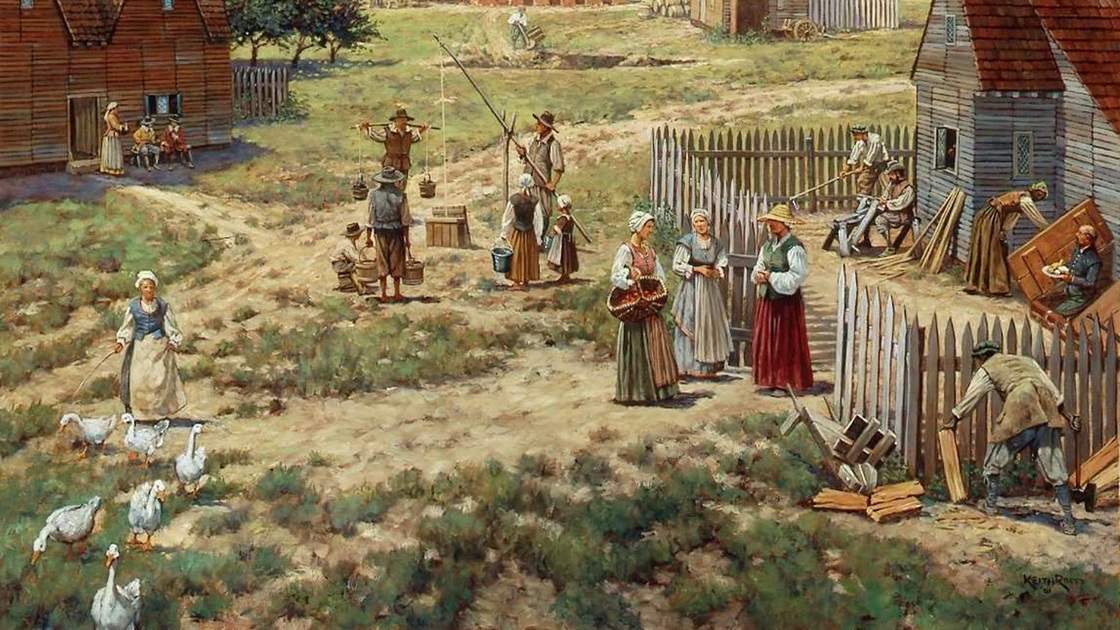
Western Americans in the 1700s—unlike Americans today—knew the value of a housewife. David McCullough writes in his book The Pioneers: “Most importantly there were more women now to share in the endless work and hardships of life on the frontier.” He is referring to the generation who headed to the Appalachian Mountains to settle in the wilderness lands.
He continues: “Pioneering demanded joint effort in just about everything. The center of pioneer life was the home, where, in the old saying, a woman’s work was never done, from first light to setting sun … Besides cooking, baking, cleaning, and the full-time role of wife and mother, there were cows to milk, gardens to tend, candles and soap to be made, butter to churn…. Then there was yarn to spin, wool to weave, clothes to make for large families, clothes to wash, mend, and patch. And just as the man of the house had his ax, plowshare, long rifle, and those other tools necessary for the work to be faced, so, too, did the woman of the house—knives, needles, spoons, paddles, hickory brooms, spinning wheels, and most important, the bulbous, heavy iron pots to be seen in nearly every cabin that were used more for cooking than any other item….”
When you consider this description of the typical pioneer housewife, it is similar to the “virtuous woman” described in Proverbs 31. As it says, a woman like this is more precious than rubies, and those in pioneer days saw the value of a homemaker. Life was hard, and it demanded a joint effort between husband and wife.
Ephraim Cutler knew the value of a housewife as well. He is one of the pioneers McCullough follows in his book. He was the son of Manasseh Cutler, who is best known for his leadership in organizing and settling the northwest territory: land west of the Appalachians and around the Great Lakes that later became the states of Ohio, Indiana, Illinois, Michigan, and Wisconsin. Manasseh was also known for leading the effort to keep slavery out of that vast territory. Although he never became one of the pioneers that settled in this land (he stayed back in Massachusetts), his son Ephraim undertook the challenge.
Ephraim Cutler struck out West from Connecticut with his wife Leah and their four children. Unfortunately, two of their children died on route to the Ohio Valley—traveling through the wilderness was just as hard as living in it. Leah would later give birth to two more children before her health began to fail. On April 18, 1807, she died of tuberculosis.
Leah also knew how important a wife was as pioneers. McCullough wrote this regarding her final words: “But in her final days she had offered some advice. For his own good and that of their four children, she had insisted that he must remain single a short time only and remarry. She even went so far as to name the person she thought best suited for him. It was an act of genuine, selfless good-intent and of courage. The woman she had in mind was not someone she knew—only heard about. Her name was Sally Parker, and she was also unknown to Ephraim.”
Sally Parker was ten years younger than Ephraim. She had never been married and was also from Massachusetts, until she travelled west with her family to settle in Ohio. He only knew her by her reputation, but Ephraim trusted his wife’s advice and followed it. So he wrote a letter to her, putting forth the option of marriage and asked if she wanted to meet.
She replied four days later, and according to McCullough, this was her response: “She felt herself in an awkward predicament. Knowing nothing of his person, manners, tastes, and sentiments, but given his reputation as a gentleman … If a personal interview is consistent with your desire, I am induced by the principles of politeness to heed thereto.’” In other words, she said yes.
What started out as an exchange of letters between two strangers and one personal interview blossomed into a loving marriage and produced five children and lasted 38 years.
Now, this is not a model for dating. The lesson from this story is to illustrate the importance of reputation. All Ephraim knew of Sally was her reputation as a person of excellent character, a refined and cultivated mind, well-mannered, but also that she did not have a fortune behind her name. All Sally knew of Ephraim was that he was a gentleman—he was a judge in Ohio, known to be a hard worker and an upright citizen, and he loved and supported his family. That is all they knew about one another before pursuing this marriage.
This is about more than just marriage. Think about your relationships. What is your reputation like? Would someone want to be your friend based on your reputation? Would a teacher want you as a student in their classroom? Would a work supervisor want to hire you? These are all questions that can help you consider if your reputation needs some work. If you think you are at least above average in everything, then do not ask yourself. Instead, go to a teacher, peer or supervisor. You can also judge by the fruits: How many friends do you have? What is your relationship with your teachers? With your work supervisor?
Better Than Riches
Proverbs 21:1 says: “A good name is rather to be chosen than great riches, and loving favor rather than silver and gold.” “Name” can be translated as “reputation.” A good reputation is rather to be chosen than great riches. This world puts the highest priority on obtaining wealth, but this verse says we need to put a higher value on having a good name. Would you choose wealth or a moment of fun over having a good reputation?
To Ephraim Cutler, Sally Parker’s name was more important than whether she would bring money into the marriage. Ephraim would intermittently struggle with money, so if he were thinking about remarriage, this could have been an opportunity to marry someone with a great fortune and solve his money problems. But he did not choose that—he chose a wife of character, not Mrs. Money-Bags.
Joel Hilliker wrote an article in the True Education called, “Do You Have a Good Name?” In it, he wrote of this proverb: “Wise King Solomon … understood from experience and observation the value of a good name. He knew the privileges and advantages that come to the person with a good reputation” —privileges and advantages that you cannot buy with gold or silver.
We emphasize often how important it is to not be a people-pleaser when it comes to being a leader. We should not follow a crowd to disobey God’s Law or do something just to get praise or accolades. That does not get you the reputation you might think.
In 1 Timothy 3:7, the Apostle Paul instructs Timothy in qualities to look for in men to ordain as ministers. He says that these men “must have a good report.” In Titus, Paul says that a person must be blameless. We are all training to be future kings and priests; we too should be blameless and of a good report.
Having the big picture in mind also helps you see the value of a reputation. You must understand that your name can affect the reputation of other people: your family, your school, your church—ultimately, it reflects upon God. What you choose to do with your time will impact your reputation. Choose wisely whom you spend time with, and how you will spend it. Think of whom you represent.
How to Obtain a Good Name
If we then understand its value, and want to take King Solomon at his word, what can we do to obtain a good name? We can look to Proverbs 22:4, which states: “By humility and the fear of the LORD are riches, and honor, and life.” It begins with humility and respect for God. You can also look to Proverbs 21:21 and 11:27 for more direction. Mr. Hilliker called these verses a “guaranteed way to improve your name.” They all discuss following after righteousness and seeking good because this is what is going to build you a good name. Those who sincerely try to do what is right will be respected more by God and other people than if you act for attention or people-pleasing.
All the advice Solomon gives is focused on what you can do. It is your personal responsibility to cultivate your reputation. It does not depend on other people giving it to you. If you are struggling in this, know that it is not the fault of your classmates or friends—you must look at yourself. What are you doing to give yourself that name? What are you doing to change it?
“It takes 20 years to build a reputation and 5 minutes to ruin it. If you think about that, you will do things differently,” said Warren Buffett. He is saying this about living in Satan’s world, but we have the benefit of the instruction God gives His people to be forbearing and forgive one another. We all need to give each other the benefit of the doubt in God’s Family. This quote might not be as applicable to us, but it is still helpful. Also consider that after conversion, people change, and we must be positive about others’ reputations, hoping for their best. If you are struggling in this area, do not get into a woe-is-me attitude. It is much easier to change your reputation in God’s Family, but you still must put in the work. You must seek after righteousness, be humble, have a proper fear of God, and do what you need to do to build it.
Proverbs 20:6 it says, “Most men will proclaim every one his own goodness: but a faithful man who can find?” You can talk a good talk, but it comes down to what you do.
Mr. Hilliker writes in his article: “The only way to build a solid reputation is to make sure your deeds, your ‘doings,’ are pure and right. People may try to build their name by talking themselves up. But others can see through that. And if you say one thing and do another, you’ll be known as a hypocrite! God is after people who build their names through living, faith-filled action! If you live the way you should, you don’t need to boast about your accomplishments. Leave that to other people, and just stay busy doing the right. People will respect you more if they don’t hear you praising yourself. Focus on doing the right—you cannot hide the fruits.”
Proverbs 18:24 also shows a practical way to apply this by being friendly. What you do builds a reputation that gives you advantages that money cannot buy. If you are friendly to other people, you will have more friends, and that will benefit everyone involved.
Do not be a people pleaser, instead, do good deeds, be humble and friendly, and you will experience privileges and advantages that money will never buy you. Give yourself a good name.