
The first minute of British fire at Trafalgar was peak naval offense. Within that one bloody and frantic minute, the British Royal Sovereign raked the Fougueux and Santa Ana. Fifty-five guns and carronades hurled forth a “storm of cannonballs, big and small” as Royal Sovereign sailed past at 3 feet per second. Cannonade shattered the ornate decorations of Santa Ana’s unprotected stern, blew out the windows, and ricocheted through all three of its decks. Nothing could stop the 32 pounds of iron from boring through flesh, bone and wood across the entire length of the ship. Explosions of thick, jagged splinters scythed the Spaniards like wheat. There was no escape; the ship became a coffin. Nearly four men were killed or wounded every second. In that one murderous minute, 240 out of a crew of 800 officers, marines and sailors became casualties. It was carnage.
And it was exactly as Adm. Horatio Nelson planned it.
When Gen. Hastings Ismay described Winston Churchill as the “apostle of the offensive,” he referenced how Churchill often quoted the order Nelson gave to his officers before the battle of Trafalgar: “No captain can do very wrong if he places his ship alongside that of an enemy.”
Nelson’s aggressive, offensive-minded warfare won Britain many victories and inspired its warriors for centuries. His life is a great physical example of applying the offensive warfare concepts Gerald Flurry describes in How to Be an Overcomer. The Apostle Paul admonished us to be “a good soldier of Jesus Christ” (2 Timothy 2:3). Studying Nelson’s life will inspire us to go on the offensive in our own spiritual war.
Opportunities
The constant wars of the 18th century provided the captains and admirals of the British Navy unparalleled opportunities. With war came rapid promotion.
This is true of God’s Church today. God’s people have been called to fight a life-or-death spiritual war with Satan the devil, society and self, and with that comes unparalleled opportunities.
Paul wrote about this war: “No man that warreth entangleth himself with the affairs of this life; that he may please him who hath chosen him to be a soldier. And if a man also strive for masteries, yet is he not crowned, except he strive lawfully” (2 Timothy 2:4-5). Mr. Flurry writes that “strive for masteries” means contend in the battle. We cannot avoid battle. We must fight! “If you are in God’s Church, then God chose you to be a soldier,” Mr. Flurry writes. “Soldiers always have to fight, and sometimes they have to die” (ibid).
Are you willing to give your life for God’s truth in this battle? This means not compromising in persecution or trials.
With the risks of battle come opportunities for glory, titles and reward. When we contend in battle, we too have an incredible reward (Revelation 3:21). “Follow the right course and [God] will crown you, for all eternity, as the Bride of Jesus Christ. What is that worth?” (ibid). These officers fought for temporary rewards. Surely we can fight with even greater urgency and wholeheartedness for this eternal reward!
To be wholehearted, we need the vision of our future etched into our mind as Paul had it. He wrote: “I have fought a good fight, I have finished my course, I have kept the faith: Henceforth there is laid up for me a crown of righteousness, which the Lord, the righteous judge, shall give me at that day: and not to me only, but unto all them also that love his appearing” (2 Timothy 4:7-8).
Trained for War
Nelson became an admiral after years of training, experience and growth as an officer. In the late 1700s, much was demanded from naval officers. Training began around age 11. Sons of gentlemen who had never seen the ocean learned what life on a ship meant by working menial tasks, even serving with the cooks and sleeping in hammocks on the decks with the seamen. They worked aloft the topgallant sails and below with the gun crews. They learned all about knots and splicing and were taught mathematics, astronomy and navigation along with swordsmanship and marksmanship. The boys had to grow up fast, and they became men hardened in war. After six years of immersive training, if they passed a rigorous exam, they would become commissioned officers. Even as teenagers, they were expected to lead men into battle.
We need to instill in our young people a sense of responsibility and purpose. They need to know that the teaching they receive in God’s Church is preparing them for a life of service and leadership.
The competent and well-connected men continued to be promoted and were given command of ships when they became captains. They would command smaller ships such as frigates until they proved worthy to command the largest battleships, ships of the line. But their education didn’t stop. War was a training ground as well—a chance for captains to improve on the skills, tactics and understanding of previous successful admirals.
It is one thing to know God’s law, but we must apply it on the battlefield of temptation. We need to be like Jesus Christ, who not only conquered Satan (Matthew 4) but also grew in obedience to His Father in His battles (Hebrews 5:8-9).
From the fearless Admiral Rodney, Nelson learned the lethality of “breaking the line.” From patient Admiral Howe, he learned the need to master the details of naval management. From Admiral Hood, he could see what a team of inspired officers could accomplish. From Admiral Cornwallis, Nelson absorbed the confidence that, given opportunity and time, the British Navy could always beat its foe. And from his last and most important teacher, Admiral Jervis, Nelson experienced the results when trusted officers were encouraged to take initiative and make judgments based on a common understanding of the battle plan.
We need to learn from Christ, the Captain of our salvation (Hebrews 2:10), and from others. “Look at all the captains we can study who knew how to win wars!” Mr. Flurry writes. “God the Father, Jesus Christ, Abraham, Paul, Peter, John—and on and on! We have a whole library of material from Herbert W. Armstrong, a great spiritual captain. You could find a system for fighting almost anything just by studying what he wrote and what he lived through. Mr. Armstrong knew the science of this spiritual war. So did all the righteous men of the Bible. They knew how to fight! And we can learn not only from their strengths, but even from their weaknesses, if we analyze them deeply” (ibid).
Nelson intensely analyzed past victories and applied lessons to gain even greater victories for Great Britain. Along the way he developed an exemplary style of leadership.
Bravery in Battle
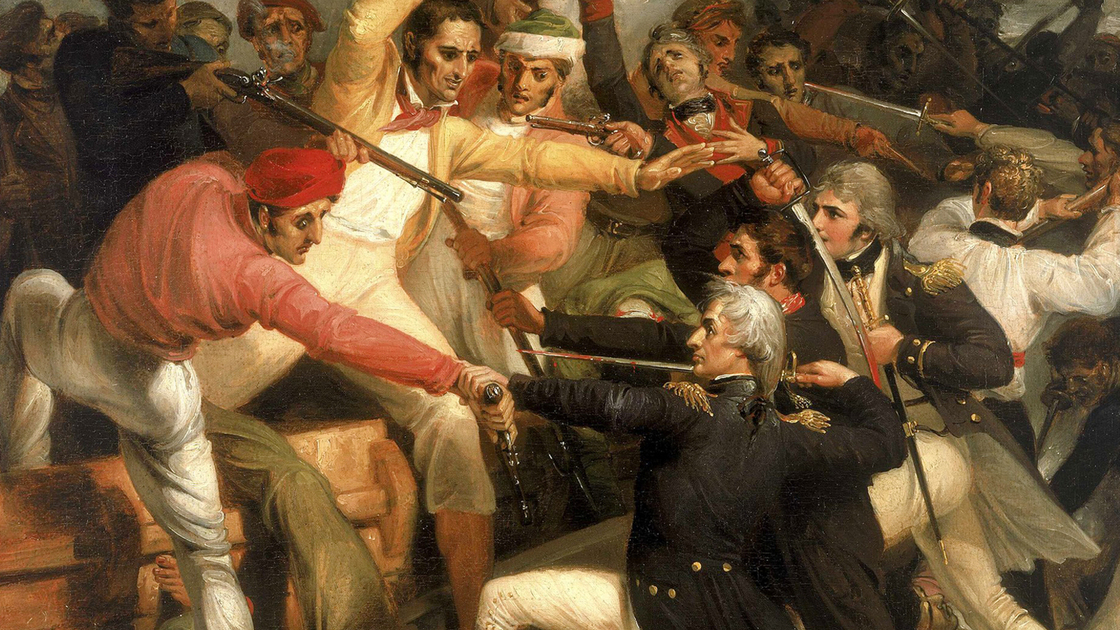
In 1797, at the battle of Cape St. Vincent, Nelson did what no admiral had done since 1513: boarded an enemy ship in battle.
During that battle, Nelson made a bold maneuver with his ship, Captain, that cut off a potential Spanish escape. Nelson’s ship came under hours of sustained enemy fire. Captain was knocked out of action, her wheel destroyed, and her rigging and sails torn to pieces. But that didn’t stop Nelson! He rammed his ship into an enemy ship, San Nicolas, that was entangled with a larger opponent, San Josef. With a cry of “Death or glory!” Nelson led his sailors. They boarded San Nicolas and took control. Then Nelson sprinted to San Josef,boarded it under fire, and took over that ship too!
When news of his speed and bravery spread, Nelson became a national hero.
Nelson led during many other attacks that no other rear admiral would have. Later that year, he nearly died in one. British gunboats were reluctant to get close to Spanish gunboats, so he decided to lead in the front to get his men moving. He barely escaped a sword blow to his head when an enlisted seaman blocked it with his arm. In another attack, Nelson was shot in the arm and it had to be amputated.
With each scrape, Nelson won more love from his men. His example of bravery amid enemy fire stirred them as no other war leader did. God wants to see real spiritual courage from us (Joshua 1:6).
Nelson’s example inspired the high morale so necessary for victory. “That is what we need in our war: high morale!” Mr. Flurry writes. “How is your morale in this war?” (ibid). With high morale, he writes, we can win three times as many battles. It starts in our prayer closet and grows as we devote ourselves to the great purpose for which God has called us: “The way for us to develop high morale is to get our hearts into God’s Work” (ibid). If we do that, we can be like Nelson and inspire high morale in others.
Unity of Command
In 1798, Nelson was given command of a crack force of 14 ships. Their mission: to hunt down Napoleon and destroy his fleet, which had crossed the Mediterranean and transported 36,000 French troops into Egypt, threatening Britain’s empire. It took months, but Nelson caught up with the French off the coast of Alexandria.
During that time, he honed the most important element of his offensive warfare: unity of command. He knew that if he could get his officers and men to follow his lead, he would give them victory.
This is a major point in waging offensive warfare Mr. Flurry lists in How to Be an Overcomer: “We must have unity of command within God’s Church!” he writes. “Jesus Christ is the Head, and we are the Body. Christ commands the Body through the government structure He has put in place in the Church, and the Body does what the Head says to do.” When the government is right, we win battles.
If we follow Christ, He will give us victory after victory. “Now, we are all cowards, let’s be honest. But when I am following Jesus Christ, I can get pretty bold,” Mr. Flurry writes. “I know where that boldness comes from, and I can handle anything through Jesus Christ who strengthens me” (ibid). It is the same for us. But we must embrace unity of command (e.g. Colossians 1:18).
Nelson established that unity by working directly with his captains. It helped that he had previously served with many of them. They were experienced men eager for glory and reward. Nelson called it “the finest squadron that ever graced the ocean.”
While the British pursued the French fleet, Nelson hosted his captains on his flagship for dinners to foster mutual respect and friendship, usually one-on-one or in small groups. Conversations were informal. All the captains knew Nelson personally or by reputation; they knew he led by example and fought from the front. They also knew that he would expect them to take initiative, fight with courage, and be offensive-minded. Nelson gave his captains his “Public Order Book,” which outlined his thoughts on tactics and his approach to fighting.
Nelson was also skilled at building bonds with the common men who served under him. Spiritual fellowship binds us together with God the Father, Jesus Christ and one another (1 John 1:3). This fortifies us for battle.
By forming these personal relationships, and with detailed written instructions, Nelson achieved unity of command. Thus, his squadron was more cohesive than those led by previous great admirals. Morale was so high the men cheered when they first saw the French fleet at anchor. They knew battle was upon them and were eager to fight.
Routing France’s Navy
The Battle of the Nile began Aug. 1, 1798, at 6:15 p.m., a time most admirals would have decided was too late in the day to attack. Not Nelson. He gave word, and the British ships raced each other into battle. They all had Nelson’s fighting spirit.
Nelson’s plan was for the British to attack the anchored French fleet from the side they least expected: between the fleet and the coast. It involved each captain navigating shallow waters and then dropping anchor at the right time to line up with their perfect target. Failure meant a ship running aground and not making it to battle.
The plan was simple, as was the system of signals: Each captain was given the freedom to use his initiative to inflict damage, capture ships, and win as much glory as possible. As it turned out, Nelson only gave nine signals before and during the battle: He was struck on the forehead and forced to retire from his command position on the quarterdeck. But no matter, because all the captains and seamen knew what to do. Signals were unnecessary.
We also need to be in tune with God’s instructions and execute them even when the physical leader is absent (Philippians 2:12).
“The most remarkable feature of the transaction consists in the eminently distinguished conduct of each of the captains of [Nelson’s] squadron,” wrote Lord Howe about the Battle of the Nile. “Perhaps it has never before happened, that every captain had equal opportunity to distinguish himself in the same manner, or took equal advantage of it.”
The fight continued through the night into the next morning. Nelson’s “band of brothers” exceeded expectations. Out of 13 anchored French ships of the line, only two escaped.
It was the most complete victory in British naval history. The British gained total control of the Mediterranean, and Napoleon and his army were trapped. After surveying the destruction of the French fleet, Nelson wrote, “Victory is certainly not a name strong enough for such a scene.”
Such are the victories we can win in our spiritual warfare with God’s help.
A Bold Plan
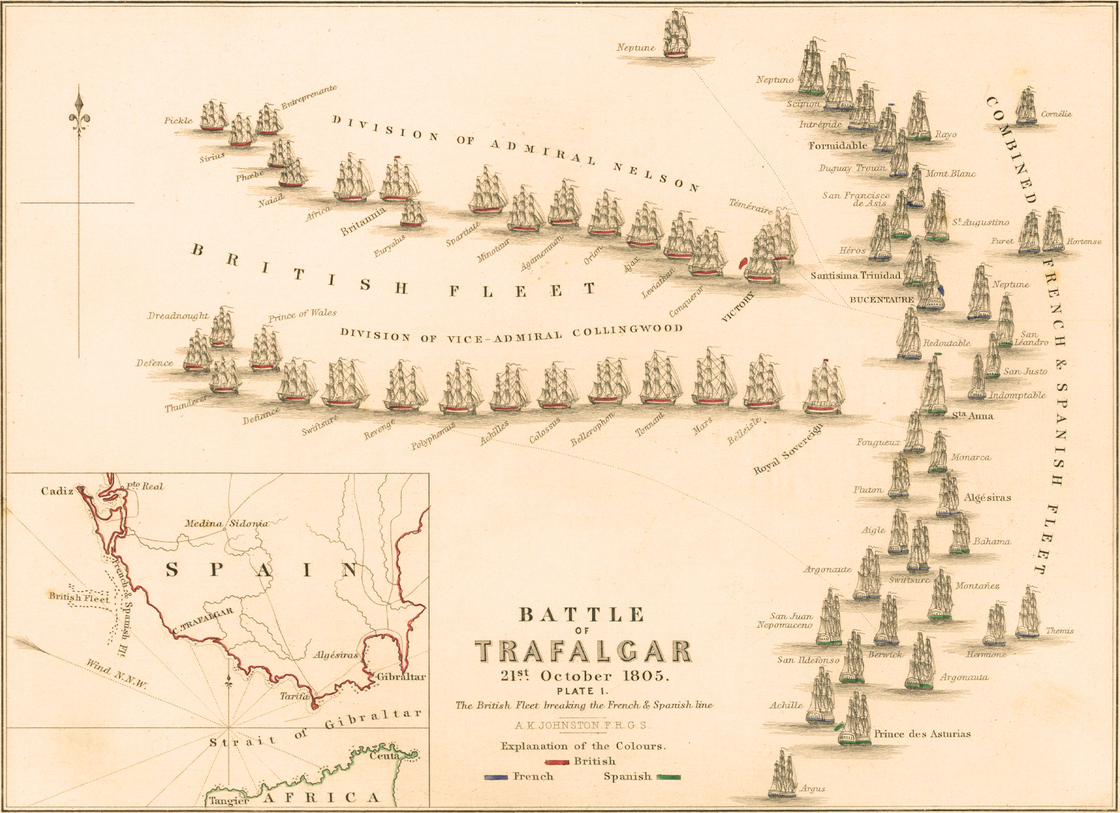
In 1805, Britain was again under threat from an enemy fleet: this time, the Combined Fleet of the French and Spanish of 33 ships. Nelson was given command of 27 battleships to meet them.
His plan, which he called “the Nelson Touch,” was to divide his fleet into two columns, each headed by his biggest ships helmed by his most-trusted admirals and captains. Each column would smash into the enemy line of ships at a key point, then keep attacking up close with the advantage of the wind at their back to keep the enemy from escaping. Admirals normally commanded from the center, but Nelson would lead in the front of one of the two columns and target the enemy’s high command of the Combined Fleet, Admiral Villeneuve’s flagship.
After Nelson explained his plan to one of his captains, he asked, “Well, what do you think of it?” The captain was stunned into silence by its boldness. Nelson answered: “I’ll tell you what I think of it. I think it will surprise and confound the enemy. They won’t know what I am about, it will bring about a pell-mell battle, and that is what I want.”
Nelson again used dinners with his officers to ensure the plan was crystal clear. He recorded their general response: “[I]t was like an electric shock. Some shed tears, all approved—‘it was new—it was singular—it was simple!’” Yes, the plan was simple: Get as close as possible to the enemy and fight hard.
Warfare in the age of sail was difficult to direct. Many factors could upset even the best plans. A lack of wind left signal flags hanging limp and unseen. A change of wind direction could remove an advantage. An admiral’s flagship might be obscured by gunsmoke or fog. Damaged ships could accidentally disrupt lines or get tangled with friendly or enemy ships. Only when ships, officers and sailors all fought with initiative and courage for the same goal could complete victory be achieved.
Nelson made sure to avoid these mistakes. He recognized that in the frenzy of battle, some captains might panic, freeze or lack tactical sense. Rather than command signals that so often could not be seen amid battle, he gave the famous order Churchill often quoted: “In case signals can neither be seen nor perfectly understood, no captain can do very wrong if he places his ship alongside that of an enemy.”
God sometimes gives us seemingly strange directions through His government. Following those instructions takes faith. But as Paul wrote, “Now the just shall live by faith: but if any man draw back, my soul shall have no pleasure in him. But we are not of them who draw back unto perdition; but of them that believe to the saving of the soul” (Hebrews 10:38-39).
God wants His people to stand up for the truth no matter the consequences. The apostles did not let fear of persecution stop them; often they charged into danger, even knowing that proclaiming God’s message would get them killed! Are you willing to go on the offensive like that? Will you stand up for the Sabbath even if it means losing your job? Even in our personal war on sin, God wants us to be bold, decisive, aggressive—going on the attack. That’s what it means to place your ship alongside the enemy. You go on the offensive, act in faith, and let God take care of the rest!
Hold Your Fire
On the early morning of Oct. 21, 1805, Nelson’s fleet caught the Combined Fleet off Trafalgar. At 6:15, he ordered his fleet to break into two columns. The enemy fleet was more than 5 miles away. It took six long hours before they were in range of each other. During those hours, 30,000 men on both sides anticipated the coming carnage.
There was much to anticipate. Both fleets’ combined firepower was greater than anything amassed on land. These two fleets carried roughly 13 times as many cannons as all the armies at the Battle of Waterloo combined. Nelson’s flagship Victory alone mounted two thirds as many guns as all the artillery possessed by the duke of Wellington. Only two to three feet of wood separated the men from the storm of iron they would face. And officers were expected to be on the quarterdeck, commanding out in the open.
The British would also be thinking of how Nelson’s plan called for them to hold their fire until they were close to the enemy. This meant they would be subjected to French and Spanish bombardment for at least 15 minutes before they could respond. The main brunt of the attack would be borne by the leading ships.
Nelson’s captains thought it too dangerous for him to be the first ship, so he agreed to place his flagship third in line of the columns. There, no officer would have any doubt about what he expected from them because they could see with their own eyes; all they had to do was follow. Nelson always led by example.
He also knew he needed his best captains in the front. He trusted them to stay calm under fire on the quarterdeck, to keep their crews disciplined not to fire until they were only 20 yards away, then to keep fighting while surrounded and being raked in return.
Sometimes we will be outnumbered in our war. We will have to stand alone and hold fast to God’s truth. Society, the media, courts and governments will fight against us; many of our members have faced this already. But we must realize that with God, we are never alone (Deuteronomy 31:6).
Nelson wanted to keep his gun crews fresh so they could fire faster when they were only yards from the enemy, which is why he had his ships wait until the last possible moment to begin firing. Nelson’s plans were always about maximum damage to the enemy.
The Combined Fleet didn’t know Nelson’s plan, but they knew the British gun crews were superior and more lethal. They knew that, even if their ships outnumbered the British, they were outmatched.
That’s how it is in God’s Church: One man with God puts a thousand to flight (Joshua 23:10).
Three miles out from the enemy, Nelson wrote his famous prayer: “May the great God, whom I worship, grant to my country, and for the benefit of Europe in general, a great and glorious victory … and may humanity after victory be the predominant feature in the British fleet. For myself, I commit my life to Him who made me; and may His blessing light upon my endeavors for serving my country faithfully. To Him I resign myself and the just cause which is entrusted to me to defend. Amen. Amen. Amen.”
God answered that prayer.
Engage the Enemy
At 11:40, Nelson gave his famous signal: “England expects that every man will do his duty.” He followed up with his favorite signal: “Engage the enemy more closely.” At 11:56, the first shots were fired, and the battle began.
Nelson could see the leading ship in the second column, the Royal Sovereign commanded by Vice Admiral Collingwood, break through first. “See how that noble fellow Collingwood carries his ship into action,” Nelson exclaimed on the quarterdeck of Victory.
Collingwood came under attack from seven enemy ships, one of which fired 100 rounds before Collingwood returned a shot. But Royal Sovereign broke through the line, and then raked Fougueux and Santa Ana. Collingwood cried out, “What would Nelson give to be here!” Royal Sovereign got raked in return and fought alone for 15 minutes before the next ship came up.
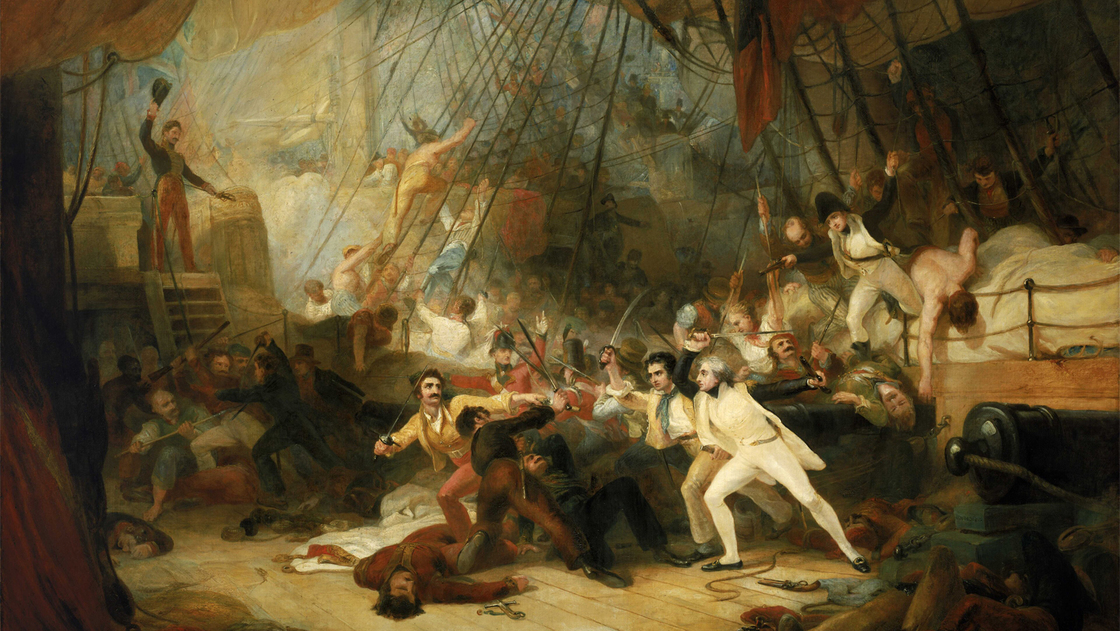
Nelson’s Victory was fired at for 20 minutes before it broke through. Before it fired a shot, 50 men were dead. Victory found Villeneuve’s flagship, Bucentaure, and raked its stern. It then found two enemy ships waiting for it on the other side. Like Royal Sovereign, Victory took a beating but kept fighting on.
Speed was crucial to Nelson’s plan. His ships had to enter battle as quickly as possible to keep on the offensive and support the leading ships. Nelson valued time and used it to his advantage, knowing the British were better fighters. As long as they could quickly close in, they would win.
“To really wage effective spiritual warfare, we must learn the value of time,” Mr. Flurry writes (ibid). Our world today is full of traps that waste our time! In this evil age, we must redeem the time (Ephesians 5:16).
The Battle of Trafalgar was especially bloody. The leading 14 ships of the two British columns bore the brunt of the Combined Fleet’s attack. Ships fought so close that oaths and pistol shots could be exchanged through open gun ports. Cannons were fired at point-blank range.
The quarterdeck was the most dangerous place on the ship, exposed to sharpshooters and smaller cannons. But it was a point of honor for officers on both sides to lead their men from that position and set the tone for the rest of the ship. The officer’s conduct was key in keeping up morale in battle. When Collingwood’s ship broke the line, he was casually eating an apple.
Sixteen-year-old Lt. Paul Nicolas recounted: “My eyes were horror struck at the bloody corpses around me and my ears rang with the shrieks of wounded and the moans of the dying.” He wanted to lie down, but he saw the example of his senior lieutenant standing resolutely on the quarterdeck. It drove away his fears so he too stood tall.
In war there are casualties. In a spiritual war, this reality is even more frightening. But we have to keep God’s master plan in mind to see through it all.
Only about half an hour after Victory broke through, Nelson was fatally shot through the shoulder by a French sharpshooter.
Half an hour later, the first enemy ship, the Bucentaure, surrendered. Nelson’s plan was working. The French and Spanish fought harder than expected, but one by one, their ships surrendered. Some of them only did so after all their masts were blown off and they could no longer fire a single gun, and one ship only after 80 percent of its men were killed or wounded. Eighteen ships of the Combined Fleet lost over 20 percent of their crews, half of which had a third killed or wounded. The leading British ships were severely damaged, but only suffered 10 to 20 percent casualties.
By the end of the battle, the British had captured 18 of the 33 ships. No British ships were destroyed. The British casualties were 458 dead and 1,209 wounded; the Combined Fleet lost the lives of more than 3,200, with 2,400 wounded, and another 8,000 captured.
“Nelson’s Touch” was a crushing hammer blow. So complete was his victory that the British gained absolute dominance of all the oceans.
Victory
It is fitting that Nelson’s flagship was named Victory. This is the example we need to follow in our spiritual war.
Can you call your own spiritual “battleship” Victory, take it into battle, and win a crushing victory? Mr. Flurry has encouraged all of us to get victories! “As Churchill said, there is no substitute for victory,” he writes. “You have to win victories in war” (ibid). No wonder Churchill often quoted Nelson.
Mr. Flurry has said we need to get more war-thinking into our minds. “We must think like people who are in a war. We are warriors” (ibid). Nelson’s life is one of Britain’s best examples of a mind filled with war-thinking. He inspired an entire empire to keep fighting until its enemies were destroyed. The British battled Napoleon until he was completely defeated. Churchill and the British Empire were inspired by Nelson to keep fighting Hitler, even when they stood alone.
Nelson embodied the lessons of offensive warfare. We can examine his battles and be inspired to fight like him in our spiritual war.
That is what Nelson, who worked so hard to inspire his officers to fight like him, would want. After Trafalgar and Nelson’s death became known, Admiral Villeneuve observed: “To any other nation the loss of Nelson would have been irreparable, but in the British fleet off Cadiz, every captain was a Nelson.”
In our great spiritual war today, every one of us must be a Nelson!