
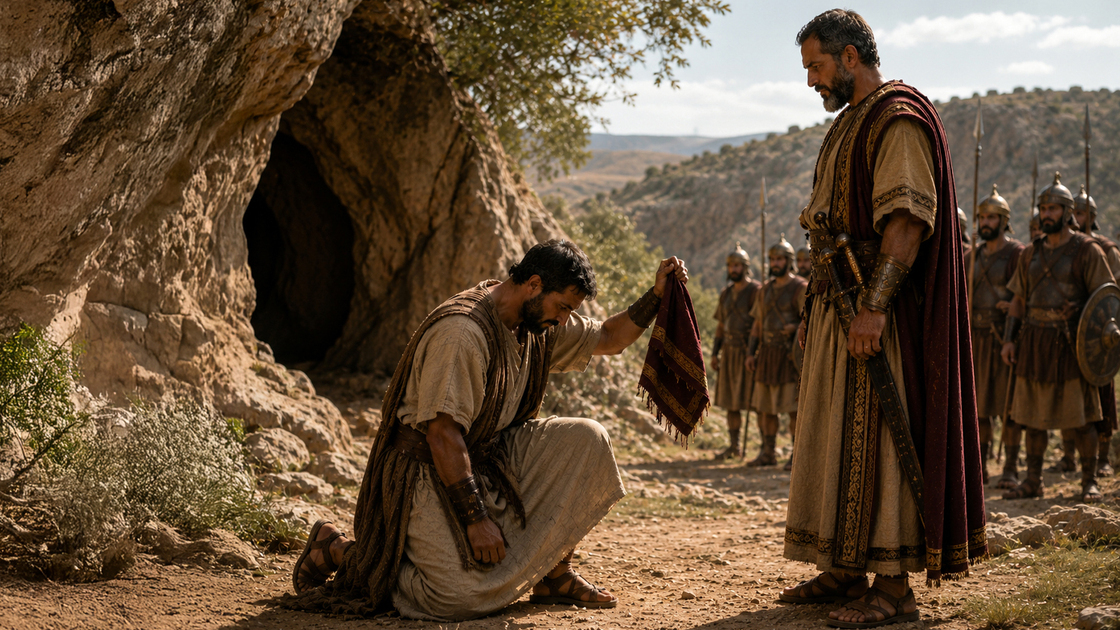
“‘Now’s your opportunity!’ David’s men whispered to him. ‘Today the Lord is telling you, “I will certainly put your enemy into your power, to do with as you wish.”’ …” (1 Samuel 24:4; New Living Translation).
King Saul had taken rest in the coolness of a cave on the west shore of the Dead Sea. Remarkably, David, whom Saul was hunting, lay hiding with his men deeper within a dark chamber of the same cave!
As his men viewed it, this was David’s chance to end years of torment as an outcast on the run from Israel’s king. They peered through the faint light in silence as David crept toward Saul with sword in hand.
God watched this event play out. It was an important test for David, the future king of Israel.
Moments later, David returned. He had no blood on his hands. Rather, he held a small cutting from Saul’s robe. His men were likely perplexed.
But as David thought on both his inaction and action, his conscience became deeply pricked. The mere act of cutting Saul’s garment moved him to deep regret. “The Lord forbid that I should do this thing unto my master, the Lord’s anointed, to stretch forth mine hand against him, seeing he is the anointed of the Lord” (verse 6).
This attitude reflected the deep love and respect David had for God. Cutting off a piece of Saul’s robe, and the thought of taking Saul’s life, shook David deeply. We can discern his attitude in the exchange he had with Saul moments later after he left the cave.
“David also arose afterward, and went out of the cave, and cried after Saul, saying, My lord the king. And when Saul looked behind him, David stooped with his face to the earth, and bowed himself” (verse 8).
David asked Saul why he listened to people who thought he was trying to harm him. He explained that this unlikely encounter proved otherwise. “Behold, this day thine eyes have seen how that the Lord had delivered thee to day into mine hand in the cave: and some bade me kill thee: but mine eye spared thee; and I said, I will not put forth mine hand against my lord; for he is the Lord’s anointed” (verse 10).
David was a warrior who had been part of many violent exploits (1 Samuel 16:18; 1 Chronicles 28:3). Taking Saul’s life would have been easy for someone who had slain a Philistine giant. But he feared God more than he feared the king. He had a deep respect and awe for God’s plan and timing. He was constantly thinking about what God wanted him to do. He had a “not my will, but yours be done” mindset.
It wasn’t the last time David would have the opportunity to shed the blood of the king who wanted to destroy him. During another mission to ambush David, Saul lay asleep in a trench (1 Samuel 26:5). David and one of his men, Abishai, found Saul asleep with his spear stuck in the ground next to him. “‘God has surely handed your enemy over to you this time!’ Abishai whispered to David. ‘Let me pin him to the ground with one thrust of the spear; I won’t need to strike twice!’” (verse 8; nlt). David quickly interjected, “Destroy him not: for who can stretch forth his hand against the Lord’s anointed, and be guiltless?” (verse 9).
David could have reasoned that the second opportunity was a sign showing he should kill the king who was intent on destroying him. He could have dealt a death blow with perhaps the same spear that Saul had hurled at him years earlier. Instead, his answer was bold and clear: This is God’s anointed. That fact would never change in David’s mind.
“David said furthermore, As the Lord liveth, the Lord shall smite him; or his day shall come to die; or he shall descend into battle, and perish” (verse 10). God’s timing and method were paramount. David wasn’t ignorant of Saul’s sins. Nevertheless, he respected the position he held; he knew God had placed him into that office and would be the one to remove him when He saw fit.
David’s loyalty to the office of the king, and to God Himself, put everything into perspective.
Later, after Saul died, a man came to David with Saul’s crown and claimed to be the one who took Saul’s life after he was wounded in battle. David rebuked this man: “How wast thou not afraid to stretch forth thine hand to destroy the Lord’s anointed?” (2 Samuel 1:14). He then executed the man for this treachery.
This account shows that David’s attitude toward Saul didn’t change even after Saul’s death! Even then, he regarded Saul as “the Lord’s anointed.”
“This was God’s man!” Gerald Flurry writes. “It wasn’t just a man—it was God’s anointed! Again—God was really alive to David! He knew that if he raised his hand against God’s anointed, he would have God to deal with! What loyalty David showed to Saul—or really, to God” (The Former Prophets). This loyalty was a defining trait that God loved.
Humanly, it is easy to reason our way around many things. But loyalty to God and His government will make us resolute.
Build the spiritual vision to see the God behind those in authority over us. Nurture the loyalty that God so loved in David and that enabled this man to serve in a kingly office!