
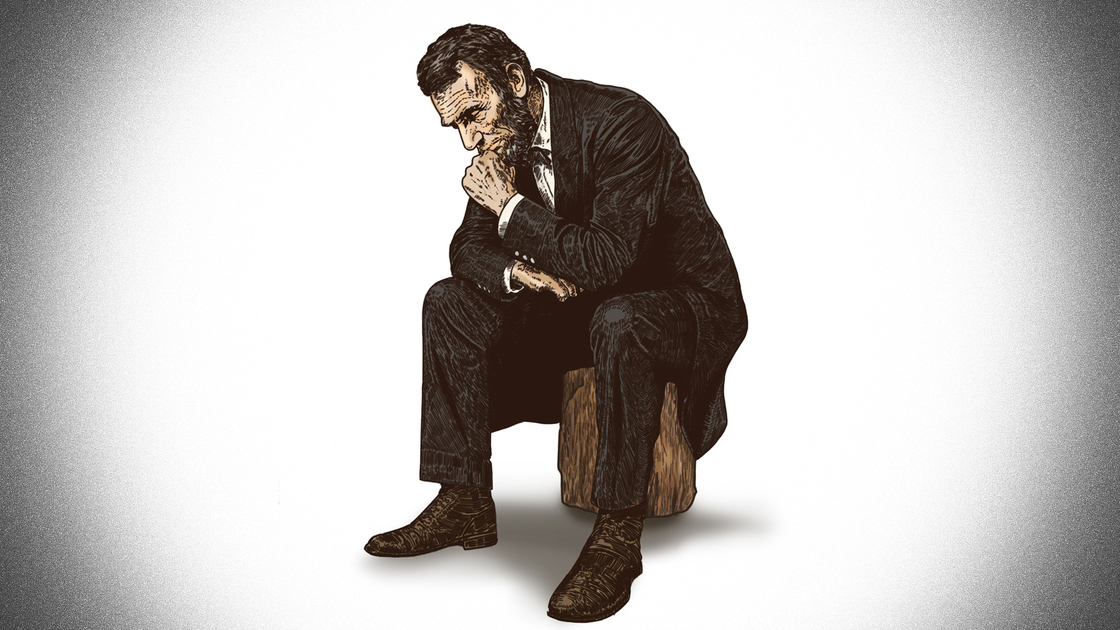
Abraham Lincoln was one of the greatest thinkers in human history. With perhaps only a year of formal schooling, he confronted the renowned orator Stephen Douglas in seven public debates in 1858 over the morality of slavery. In those exchanges, Lincoln dismantled Douglas’s arguments and upheld a vital truth from the Declaration of Independence: All men are endowed by their Creator with unalienable rights.
Many credit Lincoln’s success to his grasp of grammar, love of literature and passion for poetry. Yet Lincoln pointed to a different source. Shortly before his election as president in 1860, Congregational minister John Putnam Gulliver asked him the secret of his oratory. Honest Abe gave a striking reply.
“In the course of my law-reading I constantly came upon the word demonstrate,” Lincoln said. “I thought, at first, that I understood its meaning, but soon became satisfied that I did not. … I consulted Webster’s Dictionary. That told of ‘certain proof,’ ‘proof beyond the possibility of doubt’; but I could form no idea what sort of proof that was. … At last I said, ‘Lincoln, you can never make a lawyer if you do not understand what demonstrate means’; and I left my situation in Springfield, went home to my father’s house, and stayed there till I could give any propositions in the six books of Euclid at sight.”
Euclid, the ancient Greek mathematician, wrote Elements—a work second only to the Bible in copies sold. He began with five postulates and five common notions so self-evident that even skeptics could scarcely doubt them. From these postulates and notions, he rigorously demonstrated truths about geometric shapes through logical deduction. This kind of mathematical reasoning became Lincoln’s secret.
Lincoln applied such Euclidian reasoning in a July 1854 journal entry on slavery: “If A can prove, however conclusively, that he may, of right, enslave B—why may not B snatch the same argument, and prove equally, that he may enslave A?” he wrote. “You say A is white, and B is black. It is color, then; the lighter, having the right to enslave the darker? Take care. By this rule, you are to be slave to the first man you meet, with a fairer skin than your own. … You mean the whites are intellectually the superiors of the blacks and, therefore, have the right to enslave them? Take care again. By this rule, you are to be slave to the first man you meet with an intellect superior to your own.”
Such reasoning exposed the emptiness of any argument for slavery. It is not color or intellect that gives people an equal right to life, liberty and property. Rather, it is the fact that all human beings are made in the image of God (Genesis 1:26). Once that premise is accepted, the equality of rights follows as self-evidently as Euclid’s notion that “Things that are equal to the same thing are also equal to one another.”