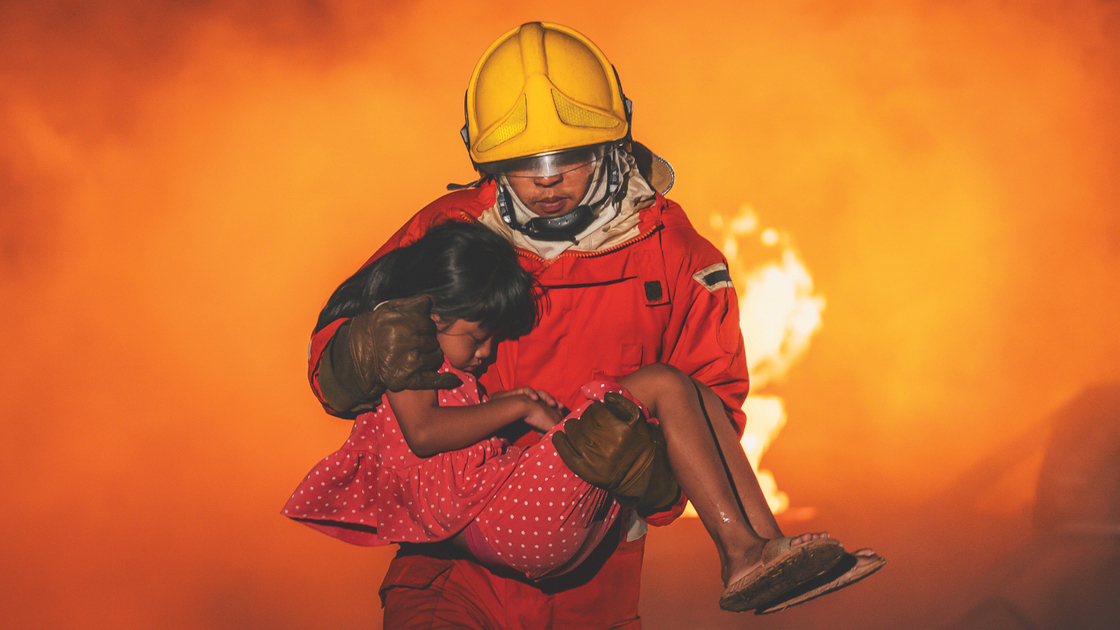
When firefighters stand in front of a burning building with people entrapped, every second counts. If they hesitate, those trapped will be consumed by flames. If they lack coordination, they risk losing their own lives or those of their fellow firefighters.
If they act, they save people’s lives.
Their job is extremely dangerous, involving burns, smoke inhalation, structural collapses, falls, explosions and entrapment. Last year in the United States, 81 firefighters died. They lost their lives while saving others.
Firefighters often suffer from long-term health issues, including respiratory problems; higher cancer rates due to exposure to carcinogens in smoke, debris and chemicals; and heart disease due to physical strain, heat, stress and toxins.
Dealing with life and death, firefighters often carry emotional and psychological burdens. They have high rates of post-traumatic stress disorder, depression, anxiety and compassion fatigue. There are times they witness families’ grief, knowing they had been delayed just a few minutes by traffic—or maybe had acted too slowly. They are haunted by the thought that they could have acted more quickly or done more.
But the risk to their own lives and the mental anguish are overshadowed by the opportunity to save someone’s life. This drives them to be urgent, to move swiftly and summon courage for the next fire. They accept those risks and pay those emotional costs—to save people. The fulfillment in successfully rescuing someone, the gratitude from survivors, the knowledge that their presence gives people a fighting chance—outweigh the costs.
Every day holds the possibility of saving someone’s life from a collapsed structure or car wreck. Every shift holds the possibility of snatching someone out of the fire before the flames consume them.
That’s why, when others run out of burning buildings, firefighters run in: so that others might live. They have a deep sense of duty and of fulfillment in making a difference. They have a certain mindset—a certain attitude of heart.
What About Us?
Like firefighters, we need to be aware of the extreme dangers to our calling, and we need the right kind of motivation to face them.
Jesus Christ set the ultimate example. He risked His eternal life to save ours. Our Christian calling means we must follow Christ no matter the danger. The apostles walked in Christ’s footsteps and accepted the risks of this calling. They didn’t fear imprisonment or death—and most of them were killed doing God’s Work.
We who are called today face greater spiritual risk than those called in the future. But like Christ, we must be willing to risk everything to save spiritual lives. To do this, we must develop the heart of a savior.
A firefighter isn’t called to save his own life. We likewise are not called merely for our own salvation. We are called to warn this world about the approaching flames of a nuclear holocaust. We are called to warn our Laodicean family about the flames of the lake of fire. We are called to stand at Christ’s side at His return to bring salvation to the world. We are called to save both physical and spiritual lives.
We are called to be co-saviors.
What ‘Co-saviors’ Means
“Jesus Christ is the first of the firstfruits. He is the firstborn of many brethren,” Herbert W. Armstrong wrote in Mystery of the Ages. “… The Church is being called to be changed, developed in character, and finally born at Christ’s Second Coming as God beings, to be kings and priests under Christ when He will set His hand to save the world.
“In a sense, then, the Church shall become co-saviors with Christ.”
Two things were required of Christ to become the Savior of the world. “First it was necessary for Him, who was the Maker of us all, to die for all, thus paying the death penalty in our stead. No one could do this but Jesus Christ alone,” Mr. Armstrong continued.
“But many have not realized that we are not saved by the blood of Christ. … [W]e are reconciled to God the Father by the death of Christ, but we shall be saved by His life—by the resurrection. … Jesus alone could make the sacrifice in payment of our past sins. But the world must look for salvation through His life after His resurrection. … After we have attained to the resurrection of the dead, as the wife of the Son of God, and members of the God Family, we shall be not only heirs and coheirs with Christ, but in a sense, co-saviors. … As kings and priests, the Church in the resurrection will be co-rulers under Christ in restoring the government of God over all nations. But we shall also be, as priests, co-saviors with Him in saving the world” (emphasis added).
Christ’s sacrificial mindset, as well as His victory over sin and death, reveal what it means to have the heart of a savior.
We need to be developing that mindset today. It is at the core of our calling!
We learn to think as co-saviors by supporting God’s gospel message to this world and warning about end-time events.
God is trying to build within us the heart of a savior. Christ is our Savior, and we need to follow His example in building a heart of a savior.
A Time of Opportunities
In our May-June 2026 issue, Gerald Flurry wrote: “The last six verses of Jude are fascinating and inspiring. I consider them some of the most beautiful verses in the Bible.”
Jude 18 refers to the “last time.” This refers to the extreme end, as Mr. Flurry explains in Jude.Time refers to the “measure of moments,” as in the final moments of man’s rule before Christ’s return. Time also means “time of opportunities.” Mr. Flurry writes: “It is the worst time ever. But it is perhaps the best time ever for opportunities—just prior to the Second Coming of Christ. There are spiritual and physical opportunities galore in this end time. However, there is only a very short span of time to exploit those opportunities.”
This is an exciting time in God’s Work—a time of opportunities. We need to exploit the opportunities in front of us.
It also means we have a grave responsibility.
Eternal Lives Are at Stake
Jude continues: “Keep yourselves in the love of God, looking for the mercy of our Lord Jesus Christ unto eternal life. And of some have compassion, making a difference: And others save with fear, pulling them out of the fire; hating even the garment spotted by the flesh” (verses 21-23).
Jude wrote these verses right before the horrible destruction of Jerusalem in a.d. 70. He also hearkened back to past destructions. Verse 7 reads: “Even as Sodom and Gomorrha, and the cities about them in like manner, giving themselves over to fornication, and going after strange flesh, are set forth for an example, suffering the vengeance of eternal fire.” Fire rained down on those cities. God sent angels to snatch Lot and his daughters out of it. Lot tried to convince his sons-in-law to flee, but they refused. They died in the flames.
Today we are approaching the nuclear flames of World War iii. The prophesied seventh resurrection of the Holy Roman Empire is rising, and bombs are about to fall. This coming war will be far more terrifying than anything in history. It will be so bad that, “except those days should be shortened, there should no flesh be saved: but for the elect’s sake those days shall be shortened” (Matthew 24:22). God’s very elect have a direct hand in shortening this suffering!
What would you give if you could save a relative or even a total stranger from this coming destruction?
“The first-century holocaust was something that caused Jude to do everything he could to try to snatch people out of the fire, physically and spiritually, just like we are doing today,” Mr. Flurry writes. “If people don’t wake up and repent, the fire will consume them!” (ibid).
Millions of people will die in the flames of nuclear fire. That is the reality we must face! But by getting God’s message out, we can save some from those flames. Though the world at large will likely ignore God’s warning, some will respond.
“A still deeper meaning is that these people are also being snatched out of the lake of fire” (ibid). The lake of fire is reserved for those who knew God’s truth but rejected it. We can save some from this fatal decision.
Can you fathom the opportunity—really, the responsibility—God gives us? We can make the difference in saving people from eternal death!
Every day, the flames of nuclear fire come closer, and the window of opportunity to save lives is closing. Only a few short years remain to snatch people out of the fire of the Great Tribulation or even the lake of fire!
These verses tell us that our efforts make a difference! To the degree that we allow God to use us, we have the opportunity to save people from dying. Our zeal or complacency makes a difference in whether people go into the Tribulation and the lake of fire!
That is hard to wrap your head around, but it is crucial to consider deeply. You can snatch someone out of the lake of fire! This means you can make a difference in whether someone who is currently departing from God repents and enters eternal life in God’s Kingdom or not. That is what the Bible teaches.
“We have a Savior, and He is teaching us to be co-saviors,” Mr. Flurry writes. “God is teaching us how to save people today and during the Millennium. We are becoming like the Savior God!” (ibid).
Without Christ, none of us would be here today. And without the firstfruits, God’s Family would also stop growing!
These verses in Jude give three steps to building the heart of a savior.
1) Keep yourself in the love of God
“Keep yourselves in the love of God, looking for the mercy of our Lord Jesus Christ unto eternal life” (Jude 21). That refers to the agape love of God. We must build that love in our daily lives through the Holy Spirit. God is love, and we must work to become love as God is.
This means we must keep the law of God, which is outgoing concern for God and others (1 John 5:3; 2 John 6).
It also means being grounded in God’s truth. “God warns us to keep ourselves in God’s love,” Mr. Flurry writes, “and all the revelation given through Mr. Armstrong and the pcg today” (ibid).
We develop that love by allowing God’s Spirit to lead us to serve and sacrifice for others as Christ did and, ultimately, to lay down our lives for a brother.
Keeping yourself in God’s love also means praying with that love—making intercessions for God’s Work, God’s Family and the world. That is building the heart of a savior.
Firefighters must guard themselves. One lapse in judgment, carelessness or a lack of discipline can create tragedy. A mistake can cost his own life or a comrade’s life.
If we don’t keep ourselves in that love, it will wax cold. That has happened to thousands of people in the Laodicean era (Matthew 24:12).
Every day we need to go to God to seek that love in prayer and Bible study. If we don’t do that, we will lack the love to help others. This means that others will die because of our selfish focus.
Christ was the love of God, and He kept Himself in that love. To become our Savior, He had to obey God’s law, living a sinless and perfect life. One sin and His death would have only paid for His own sin, and we would have no chance of eternal life!
That gives us a sense of what it means to have the heart of a savior! We need to live a righteous life so we can save others.
When we sin, we not only risk our own eternal life; others might not be saved because we weren’t there for them! If we are not drawing close to God, that puts others in greater danger of losing their eternal lives.
This should motivate us to get on our knees every day in earnest prayer, interceding for God’s Work and Family. It should drive us to study our Bibles each day to get more deeply grounded in the truth, to let God teach us so we can teach others. It should motivate us to have regular fasts to stay close to God.
In his sermon on Pentecost 1984, Mr. Armstrong quoted Hebrews 5:12 and said, “[Y]ou can’t take the strong meat of the gospel about Christ because you haven’t progressed that far and you haven’t learned that much about the Bible. How much do you study the Bible? You’ve got to know the Bible frontward, backwards and forwards. You’ve got to be able to teach the Bible! You sitting down there, can you go out and teach people the Bible? I don’t think you can. … I want to be wrong about that, but I don’t think I am, I’m sorry to say. … Are you studying the Bible every day? If you’re not studying the Bible every day, you’re not going to get into the Kingdom of God.”
If you’re developing the heart of a savior, your study isn’t casual: You are studying to teach, so you can save others!
Proverbs 28:1 shows that righteousness makes you bold, whereas sin weakens you, making you spiritually timid and fearful. Prayers become less effective. You become focused on self. The heart of a savior focuses on conquering sin, building righteousness, and growing in spiritual strength to be more effective in helping others.
Lanny Bassham’s book With Winning in Mind tells about a firefighter trying to rescue a mother and child from a burning multistory building. Flames were engulfing the structure. The only way to reach the woman and her child was to extend a ladder from the window of the adjacent building. A firefighter crawled across and rescued the child. But the mother feared to cross the ladder so high off the ground.
“The firefighter did the only thing he could do to save them both: He carried the woman’s child back to her across the ladder and gave her a deafening ultimatum: If her child were to live, she would have to save him,” Parker Campbell wrote. “And that is exactly what she did. Despite her fears and weaknesses, her love for her child drove her to cross that ladder to bring them both to safety. She did what she had to do when her child’s life was truly in her hands” (Royal Vision, September-October 2024; emphasis added).
When a child goes through a serious health trial, parents pray earnestly, even desperately, for healing—and build faith in God. The trial motivates them to strengthen their spiritual life—not for their own sake but for the sake of the child! That is building the heart of a savior!
Such love motivates us to overcome—even to risk our lives for others.
“What does it take for you to cross the ladder? What stirs you to come out of this crumbling world? Much like that burning building, this world is soon to collapse. We may have to overcome some gargantuan fears and weaknesses in life, but we are called to be co-saviors with Jesus Christ—to literally help Him rescue others from spiritual death” (ibid).
Spiritually, we need to summon heroic effort to fulfill our job: rushing into burning buildings to reach trapped individuals, climbing smoke-filled stairs without proper air supplies, going into disaster areas to try to save people!
The Apostle Paul set a magnificent example. Read 1 Corinthians 9:16-22 to see how hard he labored “that I might by all means save some.” He had the heart of a savior. We all need to grow in such thinking.
2) Have compassion, making a difference
This step can be found in Jude 22. This pertains to how we help save other Church members and even those in the world. In God’s Church, we must look out for each other, have compassion for each other, love each other—and make a difference in each other’s lives.
“We really can make a difference by helping those in the Church who need it. We all need help from time to time” (Jude). “We can make a real difference in this Work and for this world,” Mr. Flurry wrote. “In fact, God expects each of us to make a difference in the Church. … We have been called to make a difference” (Royal Vision, op cit).
We easily underestimate the difference we can make in another member’s life. Think about this when you come to Sabbath services. With compassion, you can lift someone out of discouragement in a trial, making a difference in his spiritual growth. With edifying fellowship, you can strengthen congregations, eradicate gossip, and build unity.
Christ our Savior set the example: “Surely he hath borne our griefs, and carried our sorrows …” (Isaiah 53:4). To some extent, we can bear others’ griefs, carry sorrows and encourage them. Don’t just leave them alone in their grief and sorrow.
Christ has called us to bear one another’s burdens (Galatians 6:2). When we don’t serve out of outgoing concern, we get weary in doing what God asks of us (verse 9). We can get selfish and think more about immediate comfort. God says, Faint not! In the end, your sacrifices will be worth it!
“As we have therefore opportunity, let us do good unto all men, especially unto them who are of the household of faith” (verse 10). That is building the heart of a savior! We are thinking about all men making it into God’s Family, especially those in the Church.
“Greater love hath no man than this, that a man lay down his life for his friends” (John 15:13). Christ our Savior laid down His life for us. Only He could die for our sins. But notice: “Hereby perceive we the love of God, because he laid down his life for us: and we ought to lay down our lives for the brethren” (1 John 3:16).
This means we must put the needs of the brethren over our own. One of Paul’s helpers, Epaphroditus, “nearly died for the work of Christ, risking his life …” (Philippians 2:30; Revised Standard Version). Priscilla and Aquila also “risked their necks for my life” (Romans 16:3-4; rsv).
How much do we love the other members in God’s Family? How much compassion do we have? How much of a difference are we making? How much are we trying to help save each other—help them attain eternal salvation?
All this requires discernment and spiritual maturity. But if we do it right, it can save lives!
“Now we exhort you, brethren, warn them that are unruly, comfort the feebleminded, support the weak, be patient toward all men. See that none render evil for evil unto any man; but ever follow that which is good, both among yourselves, and to all men” (1 Thessalonians 5:14-15). Sometimes some of God’s people can be feebleminded or fainthearted. People can lack faith or spiritual strength or get bogged down in personal sin. We must comfort the feebleminded and support the weak. Don’t condemn them. Have compassion. Be patient. Think of Christ’s patience with you! How much patience with others do you have? Even if someone “renders evil” to you or does something offensive, don’t retaliate: “Follow that which is good”! That is how a savior thinks!
Someone with the heart of a savior is praying for others without ceasing (verse 17).
Sometimes we must do the uncomfortable and warn the unruly (verse 14). We need to comfort the fainthearted, support the weak, and warn the unruly, which means those disorderly or out of ranks. Yes, Paul admonishes members to warn, or admonish and exhort, other members who get out of line.
If a firefighter is unruly, it frays unity and endangers lives.
Thankfully, God loves us enough to warn when we get out of formation—in hopes of correcting and saving us! He wants us to build that same mindset. Sometimes saving others requires confronting them.
Most of us, if we see someone unruly, want to just ignore it—or, worse, gossip about it. If you do decide to act, you may feel more comfortable simply bringing it to the ministry—but read verse 14 again: Paul says, “[B]rethren, warn them.” God wants each of us to see that as our responsibility. That helps us develop the heart of a savior. Can you do that?
Matthew 18 shows us how to deal with problems with a fellow member: “[I]f thy brother shall trespass against thee”—take it to the ministry? No: “go and tell him his fault between thee and him alone: if he shall hear thee, thou hast gained thy brother” (verse 15).
Mr. Flurry writes, “We must be spiritual enough to make ‘a difference’ in how we deal with sinners. God’s Holy Spirit must guide us” (Jude). God wants you to take responsibility—but you must be spiritual enough to do so the right way! If you do it self-righteously or tactlessly, you can create more problems than you try to solve! But when you carry out this responsibility the right way, it truly helps and unifies the Family, and helps you grow in character and love as well.
“Open rebuke is better than secret love” (Proverbs 27:5). Do you agree? What good does secret love do? You might feel love toward someone—but if you don’t express it, it does that person no good. Open rebuke can be uncomfortable—but it can save a person’s life!
“Faithful are the wounds of a friend; but the kisses of an enemy are deceitful” (verse 6). “Are you friend enough to deliver a ‘faithful wound’ when needed? If someone you care about is doing something that is hurting him and he cannot see it or refuses to see it, someone needs to intervene. A man must not fear confrontation. Shying away from it because it is uncomfortable is a failure to love
someone enough to help him stop hurting himself or save him from a mistake” (Biblical Manhood).
This is hard even for ministers to do. But looking away is not love! Can you think of a friend, family member or Church member whom you’re concerned about, whom you see making bad choices, who could truly benefit from a faithful wound?
The flip side is, when someone approaches you to deliver a faithful wound, you must be humble enough to listen!
“Rescue those who are being taken away to death; hold back those who are stumbling to the slaughter” (Proverbs 24:11; rsv). When you see someone in danger, move—rush in like a firefighter entering a burning building! Take responsibility out of concern for that person!
If we look the other way and pretend we didn’t see, that is not love! God knows our heart (verse 12). Again, He wants to build in us the heart of a savior—one of loving others enough to be honest with them.
“Brethren, if a man be overtaken in a fault, ye which are spiritual, restore such an one in the spirit of meekness; considering thyself, lest thou also be tempted” (Galatians 6:1). Again, this is the job of “brethren.” The ministry has its part; brethren have theirs. Here is someone in danger, and you must love him enough to go in to try to save him.
But you must take precautions, or else you will put lives in jeopardy. You had better be spiritual. You had better have a real “spirit of meekness.” These things take discernment, and you may need to bring something to God’s ministry. But again, if you handle it the right way, you can save lives!
This connects directly to the first point: Keep yourselves in the love of God. We, ourselves, must be spiritually strong if we are to do good. If our spiritual life isn’t right, we are sure to do the opposite.
Mr. Flurry writes, “We have to be aware of how much damage we can do to God’s people, especially weak people” (Jude). Don’t be a stumbling block! Use wisdom in dealing with new members. They need real support and encouragement.
“We can also do great damage to our own spiritual lives. How many pcg members have been taken away by dissenters? Not just a few. Fear of God must always be with us” (ibid; emphasis added). If we are not careful, Satan will use us as a tool to divide the Church, jeopardizing lives rather than saving them!
This point is about saving the spiritual lives of those within the Church. But what about those who have left?
3) Snatch some from the fire
“Save some, by snatching them out of the fire; on some have mercy with fear, hating even the garment spotted by the flesh” (Jude 23; rsv).
“We must not have close contact with Laodiceans!” Mr. Flurry writes about this verse. “Their garment is spotted—they are ‘spiritual lepers.’ There is a contagion there that you must be so careful about! We have to hate even the garments they are wearing. In some cases, they are spiritual terrorists!” (ibid). We don’t know which is which, leper or terrorist. But those who can be saved must be snatched from the fire with fear.
“We want to try to help pluck them out, because they are in grave danger. But if we try to do that on our own, we’ll be in danger right alongside them! This ‘fire’ is the Tribulation and the lake of fire! We must know what we are dealing with and be careful we don’t get burned—we must ‘save with fear’! Eternal lives are at stake! … We can easily end up being destroyed by trying to help others” (ibid).
Nearly every person in God’s Church has a close family member or friend in this category. How much do we think about our individual responsibility to snatch them out of the fire? It should make us urgent, passionate, zealous in our prayers and support for the Work. Our individual experience helps make the bitter reality of the Laodicean era very real. It gives us a taste of how God the Father feels.
“Be careful!” Mr. Flurry wrote. “Even the garments of those of God’s people who have turned away from Him are dangerous to anybody else spiritually. They have a dangerous contagion, like a spiritual leprosy. But God says we are to do everything we can to snatch them out of the fire …. The Great Tribulation is coming. Eternal fire awaits those who don’t repent. We must do everything we can, now! Our offerings and other ways we serve God help snatch them from the fire” (Royal Vision, op cit). Again—we live in a time of opportunities!
In firefighting, minutes or even seconds often separate life from death, both for victims and for firefighters themselves. With modern synthetic furnishings, plastics and construction materials, fires today burn faster and hotter than ever. What might have taken 20 to 30 minutes to burn in an older home now burns in as little as 3 to 5 minutes. A fire presents a very small window of opportunity to act. If a firefighter is too slow or hesitates, he will miss victims or be too late.
Firefighters must be vigilant, decisive and disciplined. They need to be brave, but they also need razor-sharp timing and judgment. One speedy correct action can save multiple lives. At times, they jump through windows for immediate extraction, or crews will push through superheated hallways to grab a child at the last second. When a window of opportunity closes, there are no second chances.
For God’s Work today, many lives are at stake. Hundreds of millions of people in the nations of Israel and other nations are about to be plunged into the worst suffering in human history. Laodiceans are dying every day! This is a time of great tragedy—but also of great opportunities to save lives.
In Acts 20, Paul called a ministerial conference near Ephesus. The men were concerned he would be imprisoned, but Paul said he needed to go where God’s Spirit directed him (verse 22). “But I do not account my life of any value nor as precious to myself, if only I may accomplish my course and the ministry which I received from the Lord Jesus …” (verse 24; rsv). He was willing to give his own life to save the lives of others! What he was most concerned about was the state of the Church after he departed (verses 28-31). Like Mr. Armstrong, he warned
of rebellious leaders within who would destroy people’s spiritual lives.
In Acts 21, Paul was warned that, if he traveled to Jerusalem, the Jews would imprison him; he responded that he was willing to be not only bound but also killed (verses 10-13).
The world is about to witness the worst kind of tribulation. Some of us may be imprisoned, even killed for preaching God’s truth. Are we willing to face that? God may use the martyrdom of a few of us to shake up our Laodicean brethren who will have to face the same during the Great Tribulation, being a witness to the world. We need to be emotionally, mentally and spiritually prepared for what is coming.
Paul was deeply moved by Stephen’s martyrdom, which he had a hand in. What if our death leads to others’ repentance? Are we willing to die?
What are we willing to do to save people? How hard are we willing to work?
Faith and Spirit-led Prayer
In this passage in Jude, God gives us two wonderful specific action steps we can apply every day. “But you, beloved, building yourselves up on your most holy faith, praying in the Holy Spirit” (Jude 20; New King James Version).
We must be building ourselves up in faith, growing in faith, learning to walk by faith, trusting God in daily decisions—and building each other up in faith, encouraging each other to live faith-filled lives.
We must also be praying in the Spirit. “That is a powerful, profound statement,” Mr. Flurry wrote. “‘Praying in the Holy Spirit’ is a high standard. We must not be sleepy in prayer. We have to concentrate. We must be attentive to what we are doing and pray in the Holy Spirit. This kind of prayer changes your life” (ibid).
These are powerful ways to build the heart of a savior!
Speaking of Laodiceans, Mr. Flurry wrote in the March-April 2020 Royal Vision, “Now, we do love those people. But how can you really serve them? Jude says to pray for them in the Holy Spirit. He says every one of you can make a difference! Each of us should take this personally! Every one of you can make a real difference to God’s Work! Even if you can’t do anything but pray—then you can pray fervently! You can pray in a quality way, and give God more time—and you will make a difference! But you can’t just sit and do nothing. You must have deeds!”
One day we will have to stand before God to give an account for what we did to save people. We don’t want God to tell us we could have done more—that we could have saved one of them—if we had just worked harder, prayed more fervently, supported the Work more diligently.
This needs to motivate our daily prayers for the Laodiceans and, for those of us directly involved in God’s Work, to strive for ever greater effectiveness and reach.
Look for ways to make a difference!
Regarding verses 21-23, Mr. Flurry wrote: “That is what Jude was saying: Look, we are in a crisis! Apostles are being martyred! You have to fill the vacuum! You have to make a difference in this Church! Every single one of you can help out” (ibid).
Spiritual lives are at stake. Flames are engulfing God’s people—our family! We must act! Don’t focus on what we cannot do—focus on what we can do, and go all in.
Shine Like the Stars
Read Jeremiah 4:19. The Prophet Jeremiah was deeply distressed by a vision of the Great Tribulation, the destruction of God’s people. That was only a type of God the Father’s emotions—the same emotions we should have, considering the worst suffering in history is almost upon us (Daniel 12:1).
“And many of them that sleep in the dust of the earth shall awake, some to everlasting life, and some to shame and everlasting contempt” (verse 2). If God calls us to save people and we fail to act,
we face everlasting shame and contempt—eternal destruction!
Tens of thousands of God’s people are in spiritual peril. Pray for God’s Work to reach them! Pray we can snatch some out of the fire! Pray that God’s Work breaks through their self-deceit. Pray for their repentance. Pray for God to rekindle His Holy Spirit in them. Pray they will contact the ministry. Even if our individual contributions save one eternal life, that’s one life saved from destruction, that’s one more God being! It makes an eternal difference!
Can we even comprehend the honor we have to be a part of this Work at this time?
“And they that be wise shall shine as the brightness of the firmament; and they that turn many to righteousness as the stars for ever and ever” (verse 3). What a reward for those who turn many to righteousness!
What can you do to turn people to righteousness today? Build yourselves up on your most holy faith. Pray in the Holy Spirit every day. Keep yourself in the love of God. Have compassion and make a difference for others, especially members. Do all you can to snatch our Laodicean brethren out of the fire!
What will people say about your effort today? What will the Laodiceans say?
“And saviours shall come up on mount Zion to judge the mount of Esau; and the kingdom shall be the Lord’s” (Obadiah 21). “Obadiah 21 shows that we are co-saviors with Jesus Christ!” Mr. Flurry wrote. “We are helping Him save some today—and preparing to save the vast majority in the World Tomorrow and beyond. What a glorious future!” (Royal Vision, May-June 2026).
“This world’s greatest need is for saviors!” he writes in his booklet on Obadiah. “God is sending them now. And whether people listen to us now or not, we shall be even more powerful saviors in God’s Kingdom.”
The heart of a savior enabled Christ to endure the greatest pains and griefs. We need to develop the same heart today so we can be co-saviors with Christ and extend God’s Family into eternity!